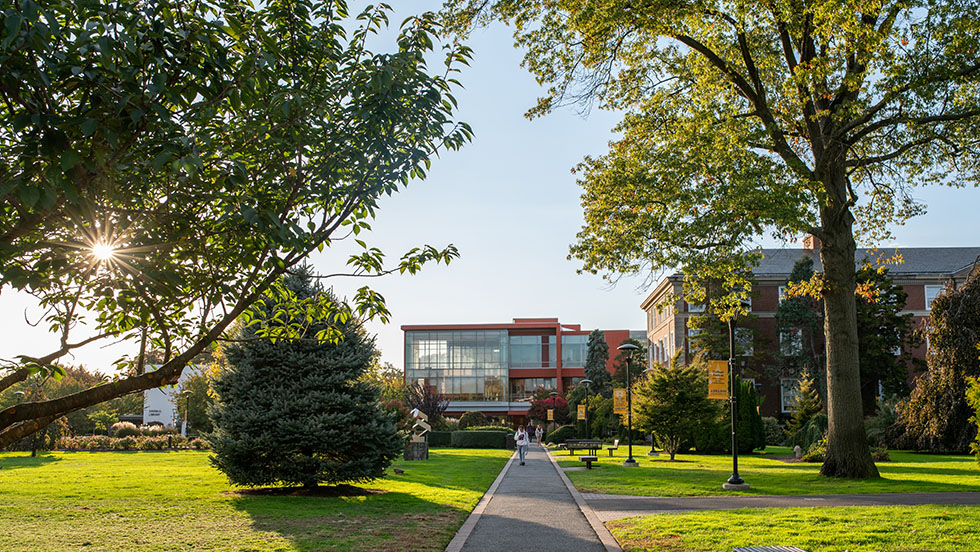
Adelphi University earns renewed arboretum status, strengthening its commitment to sustainability.
While many large urban universities are defined by high-rises and concrete roadways, Adelphi’s 75-acre Garden City campus offers a striking departure.
More than just a collection of buildings, it is a vibrant living landscape home to more than 100 species of trees and shrubs—all maintained with a 100 percent pesticide-free commitment.
That commitment has just earned Adelphi a Level I Arboretum Accreditation through ArbNet, part of the esteemed Morton Arboretum registry.
Adelphi’s Beautiful Campus Is Now Globally Recognized
This prestigious accreditation, awarded in October 2025 and valid until October 2030, places Adelphi on the global registry of accredited arboreta and public gardens.
Jay Cartabuke, the facilities project manager who oversees the University’s arboretum status, noted that this recognition enhances Adelphi’s visibility worldwide and underscores its commitment to sustainability.
“Our campus is now featured on an international platform,” Cartabuke said. “Anyone around the globe can access this registry, which aligns with our broader strategy of seeking global recognition.”
Campus as a Living Classroom
An arboretum represents more than just greenery in a garden formation; it is a carefully curated collection of trees and woody plants maintained for education, research and even public enjoyment. For more than 20 years, Adelphi has maintained a pesticide-free campus, fostering biodiversity and supporting local wildlife—most notably our beloved cottontail rabbits, who famously dart across students’ paths on their way to class.
The campus also features distinctive historical plantings, including azaleas planted by the Class of 1935 on the flagpole lawn, which have thrived for more than 85 wonderful years. Seasonal highlights, such as rows of brilliant pink cherry trees and a fragrant rose garden, remain iconic visual landmarks, especially in spring.
Cartabuke noted that while more than 100 species are believed to be present on campus, 68 have been formally identified and documented in an expanding collections database. Maintaining accreditation involves meticulous cataloging, mapping and labeling of plant species, a project that will continue through the spring and summer.
Plans are also underway to develop a dedicated arboretum campus map that showcases key points of interest and enables students and visitors to explore notable specimens across the grounds.
Sustainability: Part of Our Strategic Plan
Adelphi’s arboretum accreditation supports Goal 3 of the University’s Momentum 2 strategic plan, which focuses on sustainability and environmental responsibility.
Adelphi University has recently achieved two significant milestones: It renewed its ArbNet accreditation and its institutional membership with the American Public Gardens Association. These accomplishments enhance the University’s professional network and provide vital access to conferences, research resources and sustainability initiatives.
Benefits of Accreditation
The ArbNet accreditation offers numerous advantages for Adelphi, including:
- Validation of best practices in landscape management, which reinforces the University’s commitment to sustainability
- Acknowledgement of the campus as a living classroom, enhancing its role as an educational resource
- Benchmark opportunities to compare practices with peer institutions, increasing the University’s global visibility as a sustainable campus
Best of all, participation in this valuable program costs the institution nothing.
A Green Campus for Today’s Students
In an age when climate change and environmental awareness are paramount, maintaining a sustainable, biodiverse campus is essential. Cartabuke emphasizes that green spaces not only reflect environmental responsibility but also enhance student well-being. Areas such as the rose garden and shaded benches beneath mature trees provide students with much-needed moments of calm amid their busy academic lives.
The University plans to boost engagement by fostering faculty partnerships, encouraging student participation and possibly offering arboretum tours. A newly announced sustainability task force will further weave the arboretum into academic programs and campus initiatives.
Looking Ahead to a Greener Future
With accreditation secured through 2030, Adelphi is shifting its focus to growth and engagement. Upcoming projects include labeling plant species, expanding the collections database, improving visibility on the Facilities Management website, and developing programming that showcases the campus as a public garden.
“Our goal is to maintain and build upon what we have,” Cartabuke stated. “There’s always room to go above and beyond.”