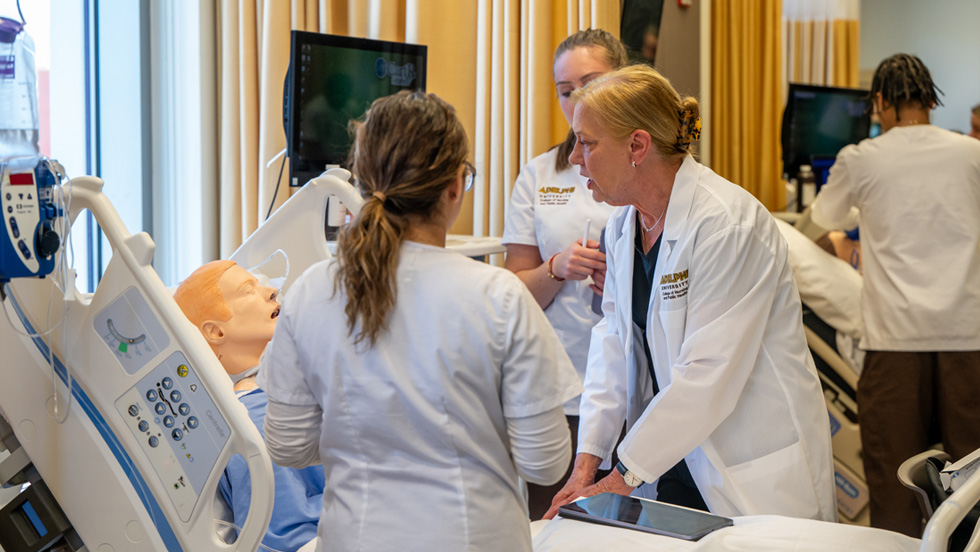
Adelphi's College of Nursing and Public Health is placing new emphasis on preparing the next generation of nurses to meet the complex needs of an aging population—on Long Island, in New York City, and beyond.
The aging of the baby boom generation is generating a boom in the need for nurses trained in geriatric care. The Adelphi University College of Nursing and Public Health is not only responding aggressively to this need, but also leading the way in developing programs to train students to provide both acute and long-term care across the patient lifespan.
“With the population living longer and the onset of new diseases, older people may become vulnerable. Managing patients with comorbidities demands more care and more specialized care,” said Deborah Hunt, PhD ’12, dean of the College of Nursing and Public Health. “In the current landscape, there are myriad job opportunities for nurses and advanced-practice nurses in long-term care. Our healthcare partners frequently reach out to share these opportunities and the challenges they face in filling some of these positions.”
The College’s increasing focus on longevity is attracting attention and support, including a $54,000 grant from New York-based nonprofit Aging in America, Inc. to enhance education in gerontology and geriatric care. This grant will open up new opportunities for immersive learning in Adelphi’s undergraduate nursing program as well as graduate, doctoral and certificate programs in adult gerontology for nurse practitioners.
This work scales beyond the College of Nursing and Public Health, too. Adelphi’s School of Social Work and Ruth S. Ammon College of Education and Health Sciences are hosting forums, offering fellowships and pioneering research in the evolving field of aging.
Where Nursing Students Learn Skills—and Compassion—for Older Adults
The Aging in America grant will support equipment upgrades to Adelphi’s Clinical Education and Simulation Lab (CESiL), along with faculty training and curriculum development. Most notably, it will introduce a new resident to the lab: a geriatric manikin—complete with realistic wrinkles, joint stiffness and simulated emotions—which students will use to engage in simulation-based learning scenarios that enhance their skills.
“By including geriatric scenarios and simulation manikins that realistically portray older adults, students can practice assessing, communicating with and caring for elderly patients in a safe and controlled environment,” said Anthony Egan, director of the simulation lab.
The geriatric manikin will join Adelphi’s current manikins representing infants, children, and young and middle-aged adults—allowing students to simulate compassionate care across the entire lifespan. For example, students can use the geriatric manikin to prepare for clinical assignments in long-term care facilities like rehab centers. They can practice transferring and positioning older patients, performing hygiene care with sensitivity, and safely responding to high-risk scenarios like falls.
A University-Wide Focus on Aging and Longevity
Beyond the field of nursing, the School of Social Work offers a unique resource that prepares students to assist an aging population: the Goidel Gerontology Fellowship in Social Work, the first of its kind in New York state. The fellowship includes a $2,000 stipend, electives focused on gerontological care, monthly colloquia with guest speakers, and opportunities to gain field experience.
“We need to prepare our students for the world of work they will be facing as professionals,” said Daniel Kaplan, PhD, associate professor of social work. “Teaching them to deal with an aging population has benefits that help all of our society.”
The College of Education and Health Sciences and its Institute of Lifelong Wellbeing and Longevity is hosting a leadership forum on successful aging and longevity in April 2026. In the full-day workshop, global experts will discuss everything from cognitive health and loneliness to innovation in the science of aging. Hariklia Proios, PhD, professor and chair of the College of Education and Health Sciences Department of Communication Sciences and Disorders, will share information about her efforts as president of the Stroke Alliance for Europe (SAFE) and its programs supporting stroke education and early detection.
The forum event ties in with recent research at the College of Nursing and Public Health that tackles a complex question: What does “successful aging” look like, and how can we achieve it? After interviewing 175 adults over the age of 65, the research team found that staying socially and mentally active will increase positive health outcomes. And, to ensure successful aging, care environments must focus on older adults’ specific social and physiological needs.
As Professor Marilyn Klainberg ’63, MS ’77, EdD, first author on the article, which appeared in the July 2025 issue of The Journal of the New York State Nurses Association, said: “Our role as nurses and educators is to help older adults find ways to stay engaged, whether that’s joining an organization, going to the library or getting out to see friends. Now we have more data to explain why.”
Looking ahead, the College of Nursing and Public Health will continue advancing its work in this evolving field and providing students with next-level resources to further their careers.
“By introducing the geriatric manikins, in particular, we are hoping to get more nursing students interested in gerontology and research in older adults,” said Dr. Hunt.
Since one in six people will be over 60 in just four years, Adelphi nurses will be providing leadership in an essential area of healthcare—helping people live longer, healthier lives.