Biology Graduate Program
Build a strong foundation for many in-demand careers in biology, biotechnology, the health professions and research with a master’s degree in biology from Adelphi University in New York.
What Can You Do With an MS in Biology?
The master’s degree in biology can prepare you for research doctoral programs and entrance into professional schools in the health sciences (medicine, dentistry, optometry, podiatry and veterinary medicine). Graduates of Adelphi’s biology graduate program acquire the tools and skills for successful careers in academia, research and industry, including careers in biotechnology, biomedical research, pharmaceuticals, conservation, environmental and patent law, and public health. Secondary school biology teachers can use a graduate program to fulfill the requirements of certain tracks for professional certification and/or expand their knowledge base.
Why Get Your Master’s Degree in Biology at Adelphi in New York on Long Island?
- Perform laboratory or field-based research with one of our expert faculty members and/or explore scientific research through the primary literature, also under the guidance of our faculty.
- Potentially earn a graduate teaching assistantship, which can cover a major part of your tuition.
- Receive personalized support to guide you toward your future career or educational pathway. Benefit from small class sizes on our Garden City campus, a personal academic adviser and a dedicated preprofessional adviser.
A Recognized Graduate Biology Program With an Easy Application? You Found It!
No minimum GPA—we review all applications on a case-by-case basis.
- No GRE required
- Bachelor’s degree in biology preferred, but other majors accepted if biology courses were taken
- No deadlines, thanks to our rolling admissions process. Apply without worry, anytime during the calendar year.
- For formal application requirements, see below under Application Requirements.
Our biology faculty are expert researchers who are noted geneticists and molecular biologists, ecologists and evolutionary biologists, physiologists, marine biologists, developmental biologists, paleontologists, microbiologists, and neurobiologists. Their work protects the planet, improves health and contributes to scientific knowledge.
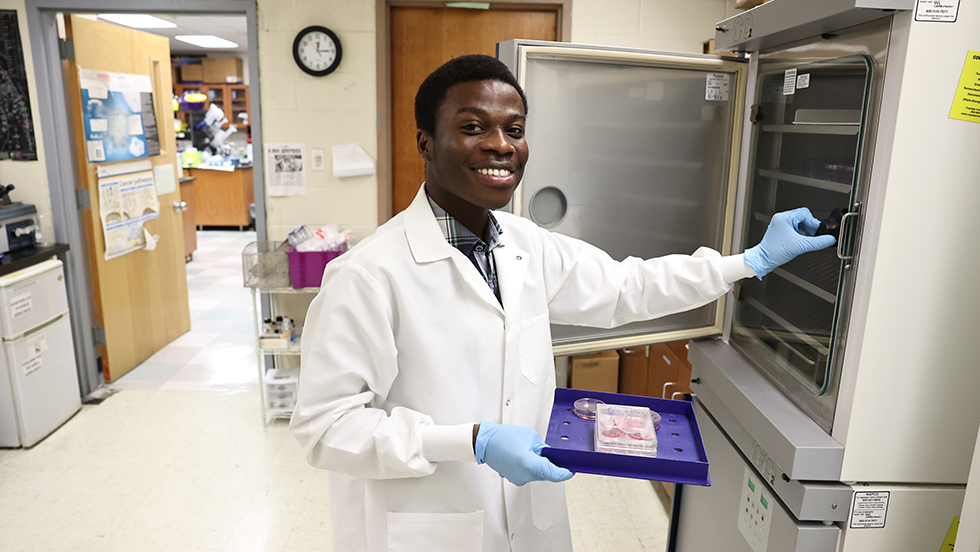
Samuel Sey, a student in the MS in Biology program, won a prestigious Jaggar Community Fellowship from Adelphi and interned as a researcher at Northwell Health.
Farmingdale State College to Adelphi Pathway
Eligible Farmingdale State College students can continue their graduate education at Adelphi through select master’s degree pathways in biology, business analytics, computer science, general psychology and sport management.
Our graduate program is flexible with personalized guidance. We support your future career in research, industry or the health professions. The program builds on your scientific and experimental/field-based knowledge, aided by faculty who are experts on such diverse topics as aging, animal behavior, bioremediation, cancer, dinosaur physiology, fish evolution, gene evolution, marine biology, neurobiology, plant signaling, skeletal development, spider ecology and xenobiotics.
 Alan Schoenfeld, PhD
Professor and Director, Graduate Biology Program
Alan Schoenfeld, PhD
Professor and Director, Graduate Biology Program
Tracks and Concentrations
Our biology master’s degree (including the biotechnology concentration) features two tracks: a thesis track for students who are interested in conducting laboratory or field-based research or a non-thesis track, which is appropriate for students who are looking to expand their knowledge of the biological sciences through analysis of the primary scientific literature.
Our thesis track is for biology graduate students who are interested in conducting novel laboratory or field-based research with the potential to be published in scholarly journals.
The non-thesis track is appropriate for biology graduate students who are looking to expand their knowledge of the biological sciences through analysis of the primary scientific literature.
Optional Concentrations
Within each of the biology master’s degree program tracks, students may wish to choose an additional concentration of related courses. Selecting a concentration is optional and the courses can be taken within the credits needed for the degree. Only one concentration may be chosen.
Concentration in Biotechnology
Biotechnology is a dynamic and growing field in which the discoveries of modern biology are applied to solve problems in medicine and agriculture. You can explore this field as a concentration within the master’s degree in biology.
The unique course of study provides a solid foundation in the sciences with training in business to give students the expertise to succeed in both scientific and business environments, including the pharmaceutical and biotechnology industries. The master’s degree program in biology includes critical training in laboratory safety, business management and ethics, and 21st century instrumentation and techniques. The required internship in a biotechnology-related company or laboratory offers invaluable firsthand experience.
I chose Adelphi’s MS in Biology because of the flexibility it offers for those pursuing a career in academia/research as well as the health professions. I went into this program hoping to solidify my decision to pursue a career in dentistry, and I was able to take classes and design a thesis that aligned with my goals. I’ve also benefited from the collegial relationship between students and faculty, both of whom are willing to help, even outside of the classroom.
Exceptional Hands-On Learning
Research is a major part of biology education at Adelphi. Students have the opportunity to participate in Adelphi’s annual Scholarship and Creative Works Conference to showcase their work to faculty and the rest of our community. Biology students have applied their on-campus research knowledge to real-life work settings, with recent internships held at:
- Cold Spring Harbor Laboratory
- Feinstein Institutes for Medical Research
- Icahn School of Medicine at Mount Sinai
- NYU Langone Hospital-Long Island
Our Research Labs
As a member of the graduate biology department, you will have access to our laboratory facilities, which include modern equipment for the study of molecular and cell biology (including tissue culture), physiology and genetics, as well as equipment for field research in marine biology, ecology and animal behavior.
Program Info
Application Requirements
Applicants must have a bachelor’s degree in biology or related field and should submit the following application requirements:
- Graduate application and $60 fee
- Two letters of recommendation
- Personal essay
- Official transcripts from all prior institutions and proof of bachelor’s degree from an accredited four-year institution
Note: International students have additional requirements.Graduate applicants with undergraduate-level work completed outside of the United States are required to send a course-by-course evaluation of their academic work prepared by a NACES member organization. Adelphi recommends you use The Evaluation Company (TEC) or IEE (discount provided for Adelphi applicants), ECE, or WES, but any NACES member evaluation would be acceptable.
Understanding Costs and Savings
Learn about the costs you can expect, and discover how scholarships, grants and financial aid packages can put an Adelphi education within reach.
FAQs: Master’s Degree in Biology
The master’s degree in biology can prepare you for research doctoral programs and entrance into professional schools in the health sciences (medicine, dentistry, optometry, podiatry and veterinary medicine). Graduates of the biology graduate program acquire the tools and skills for successful careers in academia, research and industry, including careers in biotechnology, biomedical research, pharmaceuticals, conservation, environmental and patent law, and public health.
A PhD is a terminal degree in biology and is typically needed to be able to run your own research program or laboratory. The MS (master’s degree) offered by our program is often a stepping stone to a PhD. However, it can be the degree that allows you to secure a position of higher standing than can be obtained with only a bachelor’s degree.
No, we accept students with bachelor’s degrees in related disciplines. We also accept students with unrelated majors, but who have taken the background courses needed to be successful in our program. This is reviewed on a case-by-case basis.
Our master’s degree is designed to take two years to complete. It is possible to take longer to complete by attending part time. The length can sometimes be shortened (perhaps by a semester) if summer courses are taken. In general, a minimum of three semesters is needed.
We have concentrations in molecular biology, in physiology, and in conservation biology, ecology and evolution. Students typically take courses toward these concentrations as part of their normal credit requirements, which allows them to take courses that interest them the most. We also have a concentration in biotechnology.
The biotechnology concentration is unique because it is aimed at helping students build a career not only doing bench science, but also in the management sector of biotechnology companies and related industries. It contains a blend of biology courses, business and management courses, and an internship to make our graduates more ready for management-level positions.
At present, our graduate program is only offered in person, although we do have some online courses. We believe that hands-on laboratory work is very important for our graduates, and this necessitates being on campus to work in our classroom and research laboratories. Because our degree is in person, our students form a tight-knit community and are able to help each other to succeed both in the program and beyond.
Awards & Recognition