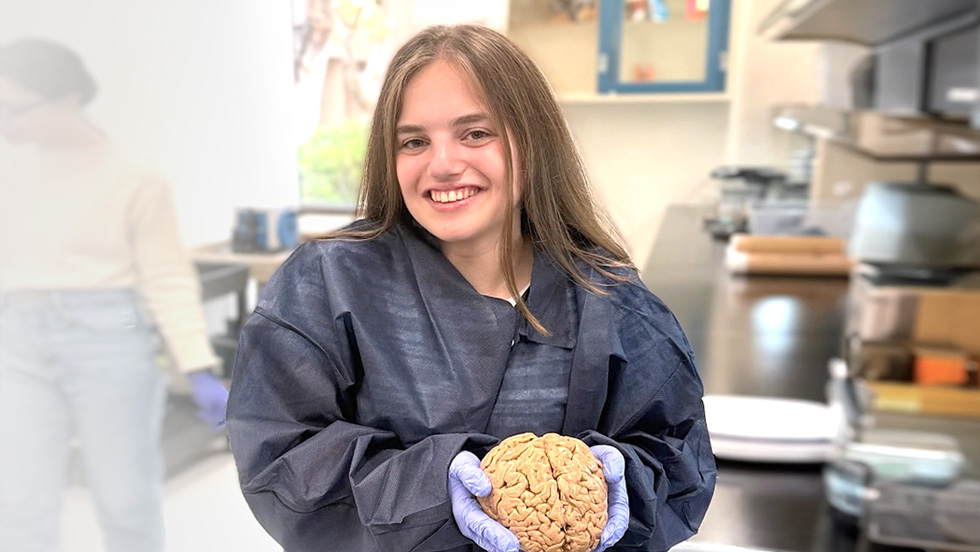
As a 2025 National Science Foundation-funded scholar at UC Irvine’s Summer Institute in Neuroscience Program, Gordon F. Derner School of Psychology student Juliana Morsello conducted research on diffusion kurtosis imaging as a way to identify biomarkers in Alzheimer’s disease—a highly competitive opportunity that immersed her in hands-on neuroscience research not often experienced by undergraduates.
Morsello’s work analyzed how microstructure of white matter relates to memory recall performance and how that relationship could be moderated by sex. When averaging across pathways, findings showed biological sex significantly influenced how white matter integrity (WMI) related to memory performance in some cases. This suggests that the connection between brain structure and memory may not be the same for all individuals and could help explain differences in memory performance on tasks such as the Rey Auditory Verbal Learning Test.
But Morsello’s ultimate goal is not just data—it’s accessibility. She wants to help science make sense to everyone—not just other scientists.
“My goal is to earn a PhD and become a civic neuroscientist,” Morsello explained, “someone who bridges the gap between scientific research and the public.”
And Morsello is well on her way. At Irvine, where she worked in Professor Michael Yassa, PhD’s lab, Morsello was one of only 20 students (out of 788 applicants) selected for this program. At summer’s end, she creatively explained her complex findings at a symposium by comparing WMI to roads on a highway, with water molecules acting like cars that move differently if someone is developing Alzheimer’s. That simple analogy is consistent with Morsello’s desire to serve as a conduit between real science and real people.
What Drew Morsello to Study Neuroscience
Growing up in the Howard Beach neighborhood of Queens, New York, Morsello became intrigued by the differences in how people think and behave—and what causes those anomalies. She was particularly attracted to Adelphi’s Cognitive Neuroscience Program, noting that few undergraduate schools offer such a clear disciplinary path.
“I wanted to focus my studies on a mix of psychology and biology courses,” she explained, “to learn more about cognition, as opposed to limiting my studies to more traditional science coursework.”
She was also drawn to the small class sizes, which have allowed her to build relationships with professors, and is inspired by the faculty’s “air of enthusiasm,” regarding sharing opportunities for growth. As a junior in Adelphi’s Emerging Scholars Program, Morsello worked with Associate Professor Christina Marini ’11, PhD, who, along with Associate Professor Dominic Fareri, PhD, directorr of the Neuroscience Program and co-chair of Undergraduate Psychology, supported her Irvine application with detailed letters of recommendation.
The Emerging Scholar Experience
Through Emerging Scholars, Morsello wrote a paper with Dr. Marini on aging veterans, examining how types of social support affect the relationship between rumination and depressive symptoms. The research, scheduled for publication in the Journal of Military, Veteran and Family Health, found that social support from military friends weakened the significant association between those symptoms. Dr. Marini insisted that Morsello serve as first author on the paper, a rare opportunity for an undergraduate, and Morsello presented her work at Adelphi’s Scholarship and Creative Works Conference and the 2025 Annual Meeting of the Eastern Psychological Association.
“Juliana has a genuine passion and interest for pursuing scientific questions and using data to help answer them,” Dr. Marini said. “The clarity of her writing, along with her ability to integrate existing research findings as a means for justifying her hypotheses, impressed me.”
Dr. Fareri serves as Morsello’s academic adviser and has watched her grow as a researcher through Emerging Scholars. The professor appreciates her combination of academic excellence, “insatiable curiosity and a remarkable ability to digest complex material and communicate it to her peers and faculty with a level of sophistication I would expect to see in advanced doctoral students.
“At Adelphi, we designed our neuroscience program to be deeply integrative, bridging the gap between molecular biology and human behavior,” Dr. Fareri explained. “Because we maintain a close-knit community, faculty can provide unique mentoring experiences that push students like Juliana to go beyond the textbook. The independent research opportunities we provide allow undergraduates to function as ‘junior colleagues,’ giving them the opportunity to propose original studies and the support to pursue prestigious national research opportunities.”
Beyond those opportunities, Morsello serves as a certified peer health and wellness educator and as an academic supervisor for Bridges to Adelphi, where she supports neurodiverse students. As she prepares to pursue doctoral studies at a destination still unknown, she remains grateful for the skills and relationships she’s built at the Derner School of Psychology and beyond, noting she might not have been able to develop them at a larger institution.
While Morsello herself is a rising star in the field, she plans to remain grounded in her desire to become a scientist who untangles the complicated, with leadership that leads to understanding.
She said, “I really want to dedicate my career to demystifying neuroscience research and supporting people in understanding and interpreting it.”