Environmental Studies and Science Research
Advance your understanding of the environment through hands‑on research, faculty mentorship and collaborative science that tackles real‑world issues.
At Adelphi, students engage in meaningful environmental research from early in their academic journey, gaining practical skills, professional confidence and opportunities to contribute to published work and conference presentations.
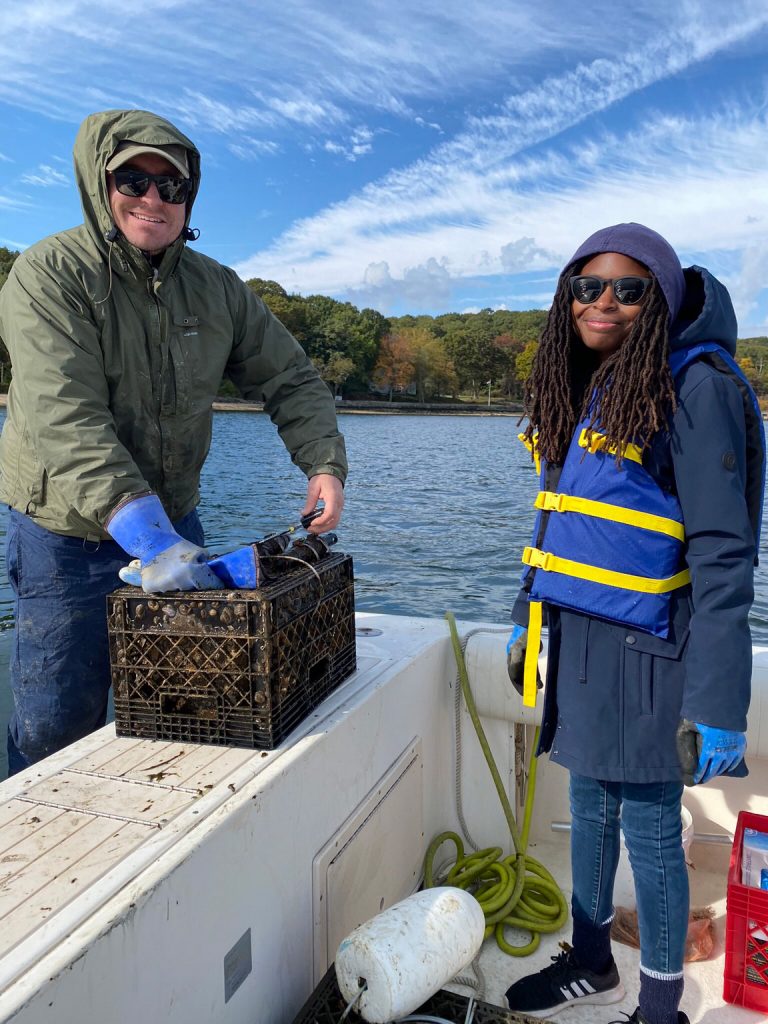
Ryan Wallace, PhD, assistant professor, environmental studies and sciences (left) with graduate student Ayanna Vaz-Baker at work in Cold Spring Harbor
As a student researcher, you might:
- Monitor water quality and ecosystem health in Oyster Bay, Hempstead Harbor, and other Long Island waterways
- Investigate harmful algal blooms (HABs), analyzing how coastal acidification and climate change affect marine life
- Participate in tropical ecology research in Australia, conducting field surveys on plant and animal populations
- Analyze environmental contaminants in soil and water, studying their impact on microorganisms and local ecosystems
- Use GIS and environmental modeling to map pollution sources, habitat changes, and conservation strategies
- Support summer research projects on local estuaries, wetlands, and marine habitats
Students present their work at the Adelphi Scholarship and Creative Works Conference and may also participate in regional and national conferences.
Undergraduate Student Research
Environmental Studies and Science undergraduates can begin research projects as early as their first year and grow their skills through fieldwork, data analysis, laboratory methods and environmental problem‑solving.
Whether completing a capstone project, pursuing honors, or gaining research experience, students receive guidance through:
- SPARK Center: Support with project planning, mentorship connections, and presentation preparation for undergraduate projects
- Innovation Center: Opportunities for interdisciplinary, project-based research and exploration
Graduate Student Research
Graduate students in the MS in Environmental Studies or the 4+1 environmental programs work on advanced research that blends field studies, applied science and scholarly investigation.
Graduate research at Adelphi prepares you for careers in science, conservation, sustainability and environmental policy, and can serve as excellent preparation for doctoral programs or advanced scientific roles.
Faculty Research and Areas of Focus
Ryan Wallace, PhD, studies harmful algal blooms in Long Island Sound and their effects on local ecosystems. His research examines how environmental factors influence the growth and distribution of algae and how these changes impact water quality, aquatic organisms, and coastal management. Students can assist in field sampling, lab analysis, and data modeling to better understand and mitigate algal blooms. Read about his grant-funded research.
Aaren Freeman, PhD, brings an interdisciplinary perspective to environmental science and ecology. His work often bridges ecology, conservation and human‑environment interactions, providing students with opportunities to explore diverse ecosystem studies and long‑term environmental monitoring. Read about how kelp and oysters keeps LI waters clean, and about his fish/wildlife grant.
Matthias Foellmer, PhD uses spiders and insects to study the evolutionary significance of extreme sexual dimorphism, gender roles, sexual conflict, and anisogamy. He is also interested in the ecology of Long Island salt marshes, focusing on anthropogenic effects such as climate change, habitat fragmentation, and pollution. Read about his fight for healthy wetlands and his research about sexually cannibalistic spiders.
Natalia Prado-Oviedo, PhD brings together multiple research disciplines to better understand the unique physiological parameters of endangered species. Her work integrates environmental factors with physiological biomarkers to examine how species respond to captive settings, directly supporting reproductive outcomes and welfare while improving daily management and conservation for species ranging from elephants and crocodiles to bears and gorillas. Learn more about the Science of Healthy Zoo Habitats.
Jonna Coombs, PhD focuses on heavy metal bioremediation, which is the use of living organisms to clean up contaminated environments. Her research focuses on three major questions: What kinds of bacteria are capable of bioremediation, and how do they survive? What are the structural changes in the proteins involved in metal resistance? How has horizontal gene transfer played a role in the evolution of metal resistance?
Ryan Ehrhart, PhD focuses on sustainability, environmental justice, political ecology and urban and rural development. He mentors students in projects that explore the intersections of environmental issues with social, cultural and political dynamics and that confront the root causes of environmental problems and inequalities.
Kathryn Krasinski, PhD studies hunter-gatherer subsistence, the peopling of the Americas, Late Quaternary extinctions, cultural preservation and revitalization, community anthropology, zooarchaeology and taphonomy, with a focus on subarctic regions.
Kaiya Provost, PhD studies the evolutionary biology of birds, with particular emphasis on genomics, singing behavior, and computational biology. Her work examines how bird song varies across space and time and what these patterns reveal about evolution and communication in natural populations. She also engages in public-facing science that connects research on bird song with broader audiences, including serving as a consultant for the Only Murders in the Building TV show, where she helped teach cast members to mimic bird calls.
Brian Wygal, PhD researches environmental archaeology and human adaptation in northern ecosystems. With more than two decades of archaeological fieldwork in Alaska, his work explores human ecology, climate change, GIS and archaeological field methods.
Susan Kilgore, PhD explores sustainable practices, environmental policy, and human-environment interactions. Students work on applied research connecting science, policy, and real-world environmental challenges.
Kyungmin Lee, PhD researches environmental policy, climate change mitigation and sustainable development using data-driven methods, including machine learning and artificial intelligence. Her work examines renewable energy adoption, carbon emissions reduction and environmental well-being to inform effective and equitable environmental policies.