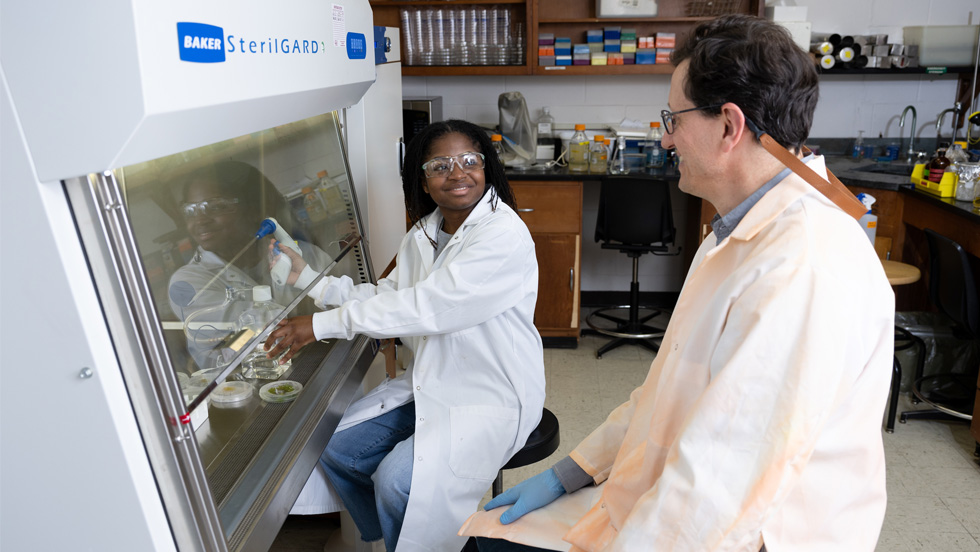
The 100 percent acceptance rate of Honors College students who applied to medical school in 2025 highlights the College’s long success in preparing students for professional schools.
“You’re accepted.”
Those are the words that students need to hear when they apply to professional schools. But the pathway into those programs is challenging, and most are turned away.
But students at the Adelphi University Honors College are finding success in their educational journeys. In fact, 100 percent of Honors students who applied to medical school last year were accepted.
Honors College students are also highly successful in gaining entrance into law school, dental school and other professional schools and graduate programs.
How does the College do this? We talked with its deans and alumni to find out.
Advanced Seminars and Lectures
“Students come to the Honors College because they’re looking for an academic home with a curriculum that’s meaningful,” said Susan Dinan, PhD, interim provost, who has served as dean of the Honors College for six years. “They’re used to being challenged and engaged, and they’re interested in a breadth of learning that’s going to accompany what they’re doing in their major.”

Nicole Rudolph, PhD, interim dean of the Honors College, assists highly motivated students to gain entry into competitive professional programs.
The yearlong courses, advanced seminars and multidisciplinary lectures at the Honors College are built around key learning goals that “map onto skills that students across majors will have to mobilize,” said Nicole Rudolph, PhD, interim dean of the Honors College and former director of the Office of Prestigious Awards and Fellowships. Students are taught not to keep classes siloed but to make meaningful connections among different concepts in their coursework, for example.
A Fulbright Scholar Heads to Medical School
That learning experience helped Kyana Gordon ’24, who earned her degree in biology and then conducted epidemiological research in Jamaica as a Fulbright Scholar, make her way to Howard University College of Medicine in Washington, D.C.
“Adelphi’s Honors College emphasizes critical thought in the discussion-style courses,” Gordon said. “The seminars helped me hone my synthetic analysis skills. That was especially important in my journey to medical school because, in taking the time to connect the dots during my research internships and clinical experiences, I found greater meaning in the practice of medicine. I realized that treating a patient requires understanding the whole person, not just the symptoms.”
A Computer Scientist, Veterinarian, and Future Attorney
Roya Parsa ’25, who earned her degree in computer science and is now in the MS in Computer Science program at Dartmouth College, also points to the thinking skills she developed in the Honors College.
“The Honors College taught me to think critically and develop a researcher’s mind,” she explained. “The core humanities courses were fundamental to developing the necessary outside-the-box thinking that I use all the time now in my research. I wholeheartedly believe that to be a good scientist, you must understand the human condition. It is imperative we understand people to perform good research.”
Sandra Pinto ’21 also stressed the way the program helped her think critically. “While the classes in my biology major gave me the necessary scientific foundation for graduate school, the Honors College taught me to think critically about important ideas from a philosophical, psychological and literary perspective ,” she said. “It cemented by character development in a way that made me stand out as an applicant.” Stand out, she did, as she was admitted to Cornell University’s veterinary school and entered the program two months after graduating from Adelphi. “My Honors College experience allowed me to show the veterinary schools I applied to that I was prepared to not only to examine, diagnose and treat animal—I would also be able to effectively communicate with people who love them,” she said. Dr. Pinto received her degree from Cornell in May 2025.
Outside of class, Honors College students can apply for summer research fellowships to conduct funded research under the guidance of a faculty member. Many use the fellowship opportunity to jump start their thesis and explore new ideas in their chosen field.
The senior thesis is a showcase for students’ enhanced analytical skills and their ability to write persuasively—abilities that are crucial in professional fields. Rene Hernandez ’23, for instance, completed his thesis on psychological operations in warfare before receiving a full-ride scholarship to St. John’s University School of Law in New York.
“Publications come out of these research fellowships, too,” Dr. Rudolph said. “In a competitive application market for professional schools, students can say, ‘Look, I’m already first or second author on this scientific article.’”
One-on-One Mentorship and Professional Guidance
Honors College faculty and staff play an integral role in helping students prepare for the next phase of their careers. Students can also work with the Office of Pre-Professional Advising and Fellowships to enter joint programs with partner institutions like New York University, Columbia University and the New York Institute of Technology.
“We have a lot of first-generation students, so we spend quite a bit of time with undergraduates to help them understand the possibilities available to them and paths they might take,” Dr. Dinan said.
Dr. Rudolph, for example, in her role as associate dean of student engagement, has helped many students craft their statements of purpose for graduate school applications.
“We had a young woman who went to law school on a free ride because her statement of purpose was exemplary,” Dr. Dinan said. “And it would not have happened if Dean Rudolph had not intervened and made it really clear why this was such an important piece to write.”
Alumni Who Offer Support and Guidance
Honors College students have yet another advantage when applying to professional school—Honors alumni.
Rachel Vacca Prater ’19, who entered the University of Pennsylvania Carey Law School after graduating from Adelphi, is one of the many students who has received advice and support from Honors College alums.
“Being able to speak to Honors College alumni who had attended such prestigious law schools was invaluable to me both during the application process and even as a 1L [first-year law student],” she said. “I was able to enter a top law school with a preexisting network of alumni who were not only willing but eager to help me succeed.”
Prater is returning the favor now as a member of that supportive network. This October, she and fellow alum Connor Coupe ’19, who received his law degree from Northwestern University, visited campus for a Q&A to provide students with insider tips on law school applications, internships and career paths.
A Fully Rounded College Experience
Honors College students don’t just shine in the classroom. They lead many student organizations on campus—from the Global Medical Brigades, part of the world’s largest student-led movement for global health and sustainable development, to the Undergraduate Law Review, which several Honors College students helped to found.
Honors College students also swept Adelphi’s 2025 Brown and Gold Awards, including President of the Year, Student Leader of the Year and Emerging Leader. Meanwhile seven of the year’s 10 Prestigious Panthers honorees—students recognized for their leadership and dedication on campus—were Honors College students.
Students within the College also make a concerted effort to build close connections and support each other in their academic careers.
“Students could be competitive for those perceived slots in medical schools, but instead, they’re very collaborative,” Dr. Dinan said. “When 100 percent of students are accepted into medical school, they don’t see each other as competition. There’s an understanding that they can all get there if they work together.”
The 100 percent acceptance rate is a point of pride at the Honors College, but it isn’t the point of the Honors College experience.
“That 100 percent is a great number, but it’s not the essence of our mission,” she said. “Our mission is to provide an experience that’s going to lead our students to satisfying personal and professional lives, whatever their profession.”