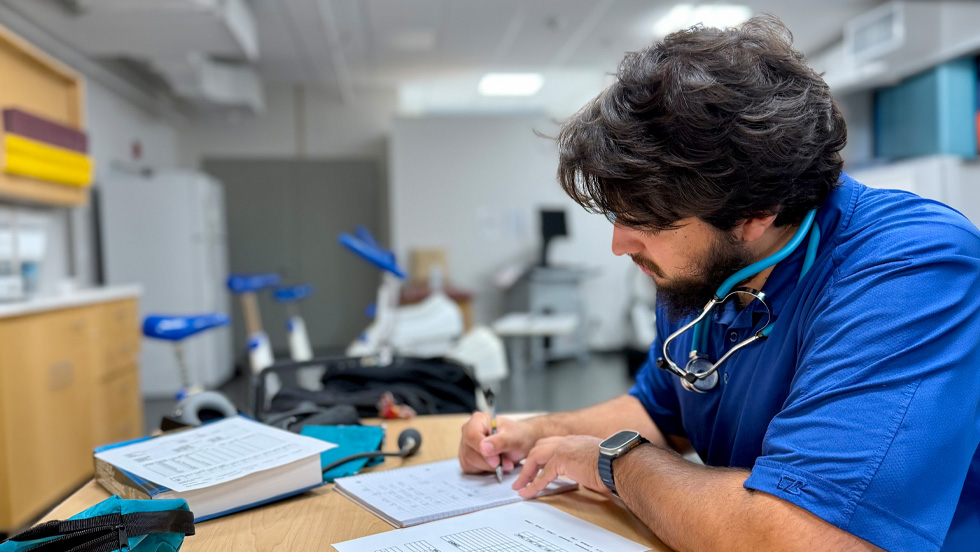
Every exercise science major eventually hits the same question: When do I get to try out what I’m learning with a real person?
At Adelphi, one answer is the Introductory Personal Training Program, a collaboration between Campus Recreation and the Department of Exercise Science that was launched about 10 years ago. Third- and fourth-year practicum students train actual clients in the fitness center, and the clients are Adelphi’s own students, faculty and staff. The program is free, and the learning goes both ways.
Out of the Classroom, Into the Gym
The practicum students serve as the trainers, with each taking on up to three clients, individually or in small groups, and working with them twice a week for up to six weeks. Exercise science faculty consult with them and critique their work throughout the program. For a student, this process means the difference between knowing a concept and being able to use it. Anyone can memorize the muscles involved in a pulldown, but it’s another thing to explain it to an anxious first-time exerciser who is watching your every move.
“Careers in exercise science, such as physical therapy, cardiac rehabilitation, personal training, and strength and conditioning are ‘people based’ vocations,” said John Wygand, clinical associate professor and practicum coordinator in the Department of Health and Sport Sciences. “The practicum experience provides opportunities for exercise science students to apply the technical skills related to exercise testing and prescription that are learned throughout their BS degree coursework to conducting evidence-based health/fitness assessments and generating individualized exercise programs.”
The Introductory Personal Training Program is not the only place practicum students put their training to work. Adelphi’s Adult Fitness Program, directed by Wygand, gives students in exercise science, physical education and health sciences another route into hands-on practice, this time with adults and senior citizens from the surrounding community. Members are required to have physician clearance, then go through a comprehensive fitness evaluation by a team that includes exercise physiologists and staff certified by the American College of Sports Medicine. Members attend sessions in the Woodruff Hall gym, with students guiding them on exercise and nutrition. For a student, it offers a longer-term setting to work with clients whose health histories and goals may look very different from those of the typical undergraduate.
“The Introductory Personal Training and Adult Fitness Program components of our practicum course comprise the majority of the course requirements and provide students opportunities to actually apply their knowledge, skills and abilities to a diverse population of real people,” said Wygand. “Students work with participants, both older and younger, who have various health concerns or who are otherwise healthy, and are able to develop both the technical and people skills central to the success of exercise science professionals. Aside from the professional development benefits for our students, the programs are a great health-related resource provided at Adelphi for the entire community.”
A Case Study (I Was the Case)
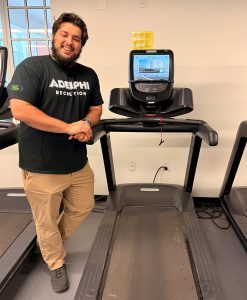
Carvajal leads personal training sessions as part of his exercise science practicum course.
I joined the program as an Adelphi staff participant in Fall 2026, paired with senior exercise science student Gabriel Carvajal. I also came with a challenge: a frozen shoulder, known medically as adhesive capsulitis, a condition that can cause pain, inflammation and stiffness in the shoulder joint.
That turned out to be a useful test for a trainer-in-training. Some elements of a standard workout wouldn’t work for me, so Carvajal had to think beyond the usual routine. Our sessions followed a simple structure that focused on one area of the body at a time. First, it was upper-body push exercises, then upper-body pull exercises, then legs. At each one, Carvajal adapted the movements as needed to my limitations, and even added a few specific exercises like pendulum swings and exercise band stretches that his research had shown would help to loosen up my shoulder.
“When I learned that Laura had ‘frozen shoulder’ syndrome, I took that information and looked for some exercises that could alleviate some of the symptoms and hopefully restore some range of motion,” Carvajal said. “Whenever we had a day that was upper body focused we would do those stretching exercises before any of the strengthening exercises, and I looked for alternative exercises as needed so we could still strengthen the muscles we wanted without stressing the shoulder too much.”
Each session began with a warm-up on an arm ergometer or treadmill and ended with a cooldown. In between, Carvajal did something I didn’t expect from a student trainer. He taught. He explained how each machine worked, what it was doing to my muscles, and how to get the most out of each exercise, citing the biology that backed up what he was telling me. For example, I learned that after a tiring and strenuous workout, I should help my body clear lactic acid and reduce fatigue by finishing with light movements—like walking, slow cycling or stretching—to keep blood flowing.
Putting My Fitness to the Test
After our training sessions ended, Carvajal had me return for a graded exercise test, or GXT, in Adelphi’s Human Performance Lab. He recorded my height and weight, then monitored my heart rate and blood pressure while I rode an exercise bicycle at steadily harder levels. The goal was to find my optimal heart rate for training and conditioning.
“We perform the GXT to find out a few things about the client’s fitness capabilities, like what work ratios will stimulate the body to reach 65 percent and 85 percent of heart rate reserve,” Carvajal said. “These numbers are used as low and high work loads, respectively, which can be translated into the settings you’d use on cardio equipment like the treadmill and bike.”
Carvajal explained that switching workload intensity mid-cardio session puts a higher demand on the heart, which causes it to adapt at a faster rate compared to keeping the workload the same. This is better known as interval training.
Seeing an undergraduate student run a clinical test with confidence made the case for Adelphi’s exercise science program better than any brochure. Carvajal explained the process throughout, told me what he was tracking and was clear that I should let him know when the task was becoming too much of a strain—which I eventually did, despite my pride. Once I said “when,” with heart pounding and leg muscles like jelly, Carvajal performed a series of calculations to provide me with a game plan for future workouts that would be maximally effective.
“The content knowledge for exercise science is provided in the classroom, but the ability to communicate that information is vital,” said Robert Otto, PhD, professor of health and sport sciences, who is also a Registered Clinical Exercise Physiologist ACSM, Licensed Exercise Physiologist, ACSM Health Fitness Director and ACSM Exercise Specialist. “The majority of exercise science majors will work with people in instructing, teaching and motivating clients. The practicum experience of working directly with a client to assess, set goals and achieve those goals is essential for success in the real world. Our Adelphi students are ahead of many of their peers because they hone their personal interaction skills in a supervised environment.”
A Win-Win for Trainers and Exercisers
The benefits of the Introductory Personal Training program to participants are clear: They get a personalized plan, a professional-style evaluation and supervised training at no cost. The program is built for people who want to start exercising and don’t know where to begin. It works especially well if, like me, you have a limitation that makes the gym feel intimidating.
For exercise science students, the experience can be a real career confidence booster. The program gets their feet wet with applying their classroom knowledge to the real world that their future careers will be in. It teaches them how to work with real clients and give real assessments, with the support of expert faculty along the way.
“When I first started with the practicum program I was nervous about how to approach everything and whether I had everything I needed to succeed,” Carvajal admitted. “But as I went through some sessions, I realized that everything I was doing was just explaining things I’ve learned in class. The hardest part was figuring out how to make sure the information I was saying wasn’t too overwhelming or confusing.”
Carvajal said that as his first training sessions progressed, he became more confident in himself, recalling more of what he learned from class. “It made me realize that what looked extremely complex in class was actually easier to understand and break down in real-world applications. When looking forward to my future in physical therapy, I can translate a lot of what I learned from my time at Adelphi and the practicum program because I have a deep understanding of exercise and how each exercise affects the body.”