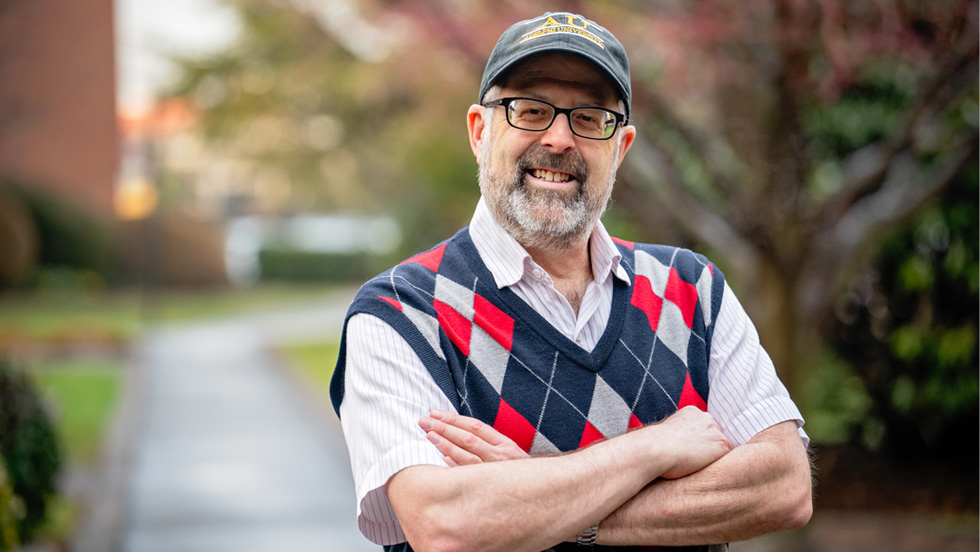
One of the nation's most prominent advocates for people on the autism spectrum, Stephen Shore, EdD, has taken his message to more than 50 countries. This March, Dr. Shore—who is on the spectrum himself—is going to Germany to give the opening keynote address at the Euro-Global Summit on Autism Research and Awareness.
Stephen Shore, EdD, clinical associate professor in the Ruth S. Ammon College of Education and Health Sciences, has traveled across the world for autism advocacy—reaching more than 50 countries and six continents. Whether he’s speaking at the UK House of Commons, delivering a keynote at the annual Asia Pacific Autism Conference in Australia or presenting at the Higashi Autism School in India, he’s on a mission to help neurodivergent people live fulfilling and productive lives.
This March, Dr. Shore is set to deliver the opening keynote address at the Euro-Global Summit on Autism Research and Awareness in Berlin, Germany. The global forum brings together leaders in autism research, clinical practice and education to share cutting-edge insights, build meaningful connections and advance their collective knowledge.
“I deliver this keynote several times around the world each year, and it’s the most popular of my presentations because it’s autobiographically based,” said Dr. Shore, who was himself diagnosed on the spectrum at an early age. “People are often interested in learning about the lives of autistic people from autistic people.”
While Dr. Shore was nonspeaking until age four, he went on to build a renowned career as a full-time faculty member at Adelphi, adjunct professor at NYU, author and editor of books, including College for Students with Disabilities, and board member for Autism Speaks and other organizations. Just last year, Dr. Shore also advised on Carl the Collector, the first PBS Kids show headlined by a character with autism.
Understanding and appreciating neurodivergent individuals
Dr. Shore will join more than 50 international speakers in presenting at the 2026 Euro-Global Summit. As a keynote speaker, he’ll deliver a customized version of his talk, “The 4 A’s of Autism for Promoting Fulfilling and Productive Lives.” Those 4 A’s—awareness, acceptance, appreciation and action—are all necessary in order to fully support individuals with autism and others with neurodivergent conditions.
“We’ve gone from the perception of autism as being a very rare psychiatric condition caused by poor parenting to it being much better known, where the Centers for Disease Control and Prevention recently announced a prevalence rate of one in 31,” Dr. Shore explained of the “awareness” component. “Now, society is much better at recognizing autism when it occurs at home, in jobs, in school or in the community.”
Meanwhile, acceptance and appreciation are essential to helping these individuals to understand and harness their differences as strengths as opposed to “curing” or “fixing” them. This is an evolution from the medical approach, which sought to treat or eliminate their differences.
“If you have a heart attack or a broken bone, you want the doctor to identify and fix the problem,” Dr. Shore said. “However, people with autism aren’t broken. It’s about working with these characteristics instead of against them.”
Connecting Adelphi to the global conversation on neurodivergence
Dr. Shore’s international advocacy runs parallel to his work teaching and consulting at Adelphi.
“The work that I do preparing for my courses to teach my students definitely has an influence on my presentations and, similarly, the work I do to present and consult around the world informs my teachings,” he said. “It’s a great symbiotic relationship.”
For example, Dr. Shore has been a longtime special adviser to the Bridges to Adelphi program, which provides personalized academic, social and career support for neurodivergent students. Bridges to Adelphi was one of the nation’s first college programs for neurodivergent students and recently expanded its support for students and alumni by launching an initiative headed by a new Board of Advisors that focuses on career success.
“I often meet with the director of the program and give workshops, both for the students who are involved with the Bridges program and for faculty and staff at Adelphi,” Dr. Shore said.
He also stresses the ripple effects of understanding and accommodating the needs of neurodivergent students on campus.
“When we talk about helping students better receive and process information in order to demonstrate their mastery of material, perhaps by providing a copy of the instructor’s notes or visual supports, these accommodations tend to help everybody else as well,” ” he said. “As we learn more about supporting neurodivergent students, we become better educators overall.”
Working alongside Temple Grandin, PhD
Dr. Shore already has a full schedule for 2026. He’s running a workshop for neurodivergent parents and parents of neurodivergent children at the the New York City Perinatal and Early Childhood Mental Health Training and Technical Assistance Center, part of the New York Center for Child Development. He’ll also be introduced by Temple Grandin, PhD—one of the most renowned autism advocates—at the Gillen Brewer School in Manhattan and give his own presentation on sensory differences in autistic people. And before he heads to Germany, he’ll first present to a collaborative of English-speaking international schools in Bangkok, Thailand.
So the question remains: After visiting more than 50 countries, where will Dr. Shore’s advocacy work bring him next?
According to Dr. Shore, not even the sky’s the limit.
“Where does it go next? That’s unpredictable,” he said. “Maybe there will eventually be an autism conference on the moon, for example. I could go there.”