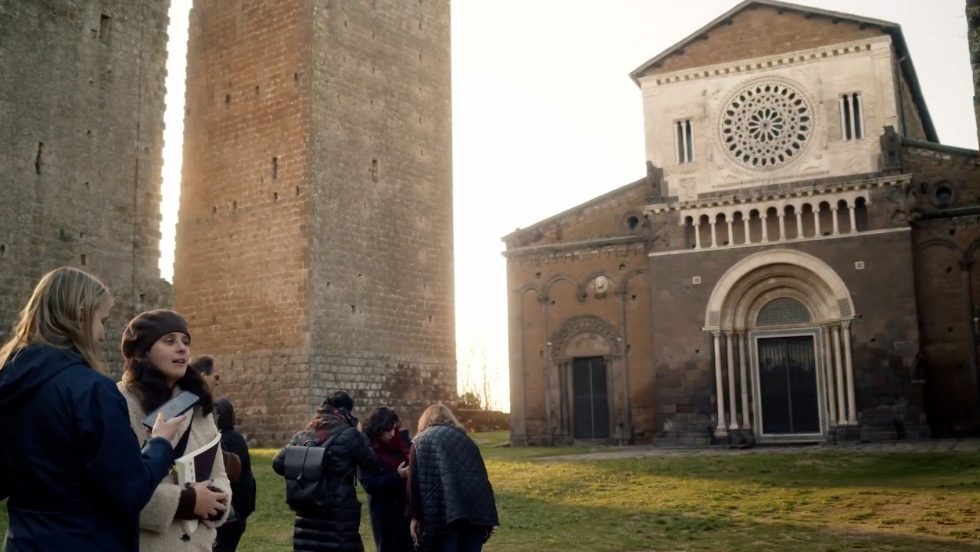
Each year, Ruth S. Ammon College of Education and Health Sciences students trade familiar hallways for ancient cobblestones. Our faculty-led Italy program immerses future educators and health professionals in a living classroom—visiting schools, exploring wellness traditions and navigating life across cultures.
Every great tradition begins with a vision. To learn more about the program’s purpose, impact, and the philosophy behind it, we sat down with Ruth S. Ammon College of Education and Health Sciences Dean Xiao-lei Wang, PhD, whose commitment to preparing students for an interconnected world is at the heart of everything this trip represents.
How does this specific trip to Italy align with the College’s mission to prepare future leaders and professionals for a globalized world?
This Italy program aligns closely with the College’s mission by preparing students to become future leaders and professionals who can work effectively in a globalized world. The program is intentionally designed to move learning beyond the classroom by placing students in environments where history, culture, education, community and daily routines are experienced as interconnected realities rather than separate systems. Through visits to schools, historically significant sites and engagement with daily life, students encounter firsthand how social values, historical development and local resources shape approaches to education and everyday practices. These experiences allow students to see that professional practice is always embedded within cultural and social contexts, often shaped by constraints and priorities that differ from those in the United States.
Working in unfamiliar linguistic and cultural settings requires students to adapt, communicate across differences and reconsider assumptions they may have previously taken for granted. Rather than observing passively, students engage in structured reflection and faculty-guided discussion that connect daily experiences to their emerging professional roles. They examine how professional practices are influenced by history, policy and community expectations, and consider how these insights inform their own future work with diverse populations.
As a result, students develop not only cultural awareness but also practical judgment, flexibility and ethical sensitivity, capacities that are essential for professionals who will serve increasingly diverse communities. More importantly, the experience helps students recognize that effective professional practice requires the ability to understand context, listen across difference and respond thoughtfully rather than relying on a single model or assumption. In this way, the program advances the College’s commitment to educating professionals and leaders who are prepared to navigate complexity, engage responsibly with diverse communities and contribute meaningfully to an interconnected world.
Why was Italy chosen as the flagship destination for this faculty-led initiative?
Italy was chosen as our destination because it offers a uniquely layered learning environment that allows students to examine how culture and community are shaped over time and across civilizations. As a crossroads of Mediterranean, European and global exchange, Italy has played a significant role in the development of many ideas, institutions and artistic traditions that have influenced Western societies, while itself being shaped by interactions with other civilizations through trade, migration, religion and conquest. This historical layering provides an ideal context for helping students understand that contemporary professional practices do not emerge in isolation, but are the result of ongoing cultural dialogue and adaptation.
Italy’s cities and regions offer living classrooms where ancient traditions coexist with modern systems. Walkable urban spaces, strong regional identities, and a cultural emphasis on family, community and everyday well-being allow students to observe learning, care and social relationships as lived practices rather than abstract institutional models. Within a relatively compact geography, students can engage with schools, cultural institutions and community settings, making Italy especially well suited for a short-term program that seeks depth rather than superficial exposure.
Italy was also selected with equity and access in mind. Many of our students come from Italian or broader European heritage backgrounds, yet would not otherwise have the opportunity to engage meaningfully with this heritage through an academically structured, faculty-guided experience. At the same time, for students without personal or familial ties to Italy, the program offers an accessible entry point into global learning, one that combines cultural richness, linguistic diversity and strong infrastructure in a way that supports first-time international travelers. Without a college-organized program, financial, logistical and experiential barriers would prevent many students from participating in study abroad at all.
Taken together, Italy provides a powerful setting for a flagship program because it allows students to explore how historical depth, cultural exchange and contemporary professional practice intersect. The destination supports the College’s commitment to preparing future leaders and professionals who can understand complexity, appreciate multiple perspectives and apply culturally responsive thinking in an interconnected global context.
Does the program provide opportunities for education students to observe classroom instruction and student learning in local schools?
Yes. The program provides education students with opportunities to observe both elementary and secondary school settings in Italy. During these visits, students are able to observe classroom instruction, student engagement and teaching approaches within a different cultural and educational context. These observations allow participants to compare instructional practices, classroom organization and student-teacher interactions with those commonly found in the United States.
In addition to observation, students have opportunities, when appropriate, to interact with Italian students and educators. These interactions allow for informal exchanges about school life, learning expectations and cultural perspectives on education. Faculty-guided reflection following the visits helps students connect what they observe to their own developing teaching philosophy, encouraging them to consider how cultural, social and policy contexts influence educational practice. As a result, the experience supports the development of culturally responsive perspectives and broadens students’ understanding of teaching and learning in diverse settings.
For health science students, does this trip help them compare the Italian healthcare system or wellness culture with the U.S. model?
While students do not formally observe the Italian healthcare system or clinical settings—as we are not allowed to have access to healthcare facilities—the trip provides meaningful opportunities for students to examine broader concepts of wellness and well-being within the Italian cultural context. Students observe how health is embedded in everyday life through dietary practices, food preparation and social routines centered around meals and community interaction. Activities such as cooking classes and discussions of regional food traditions allow students to explore the relationship between nutrition, lifestyle and preventive approaches to health.
In addition, students observe patterns related to walkable cities, daily physical activity, social connectedness and the pace of daily life, all of which contribute to broader understandings of wellness beyond clinical care. Faculty-guided discussions encourage students to reflect on how cultural values, environment and lifestyle influence health outcomes, and to compare these observations with prevailing models in the United States that often emphasize treatment rather than prevention.
Through these experiences, students gain a more holistic perspective on health and well-being, recognizing that healthcare systems operate within cultural and social frameworks. This comparative perspective helps students consider how lifestyle, community practices and cultural attitudes toward health may inform future professional practice in diverse populations.
In what ways does navigating a foreign country help our students become more empathetic educators or healthcare providers when they return to diverse New York communities?
Navigating Italy places students in the position of linguistic and cultural outsiders. They must ask for help, interpret unfamiliar cues and manage moments of uncertainty. These experiences foster humility, patience and perspective-taking. When students return to New York, they carry a deeper understanding of what it feels like to navigate systems that were not designed with them in mind. This lived empathy translates into more responsive teaching, more compassionate care and greater sensitivity to the experiences of multilingual, immigrant and culturally diverse populations.
What is one “off-the-syllabus” experience you hope every student has while in Italy?
I hope every student has a moment of genuine connection in an ordinary setting, a conversation with a local shopkeeper, a shared meal, a moment of misunderstanding that turns into insight. These unscripted encounters often become the most meaningful learning moments. When students pause, reflect and talk through these experiences together, they begin to see how learning happens not only in classrooms, but in everyday human interaction.
How can students best translate this short-term Intersession experience onto a résumé or into a talking point during a job interview?
Students can frame this experience as evidence of global competence, adaptability and reflective practice. Rather than presenting the experience simply as travel, they are encouraged to articulate the specific skills developed through the program, including cross-cultural communication, careful observation, ethical awareness and teamwork in unfamiliar environments. In interviews and professional settings, students can draw on concrete examples of how navigating new cultural and social contexts in Italy challenged their assumptions, required flexibility in communication and problem-solving, and strengthened their ability to work thoughtfully and respectfully with diverse populations.
If you were a student again today, what part of this trip’s itinerary would you be most excited about?
I would be most excited about the moments that blend learning with lived experience, walking through historic cities, observing daily life, visiting schools and engaging in conversations that connect past and present. These are the moments when assumptions become visible and open to reflection, and learning feels alive. They are also the moments that stay with you long after the trip ends.