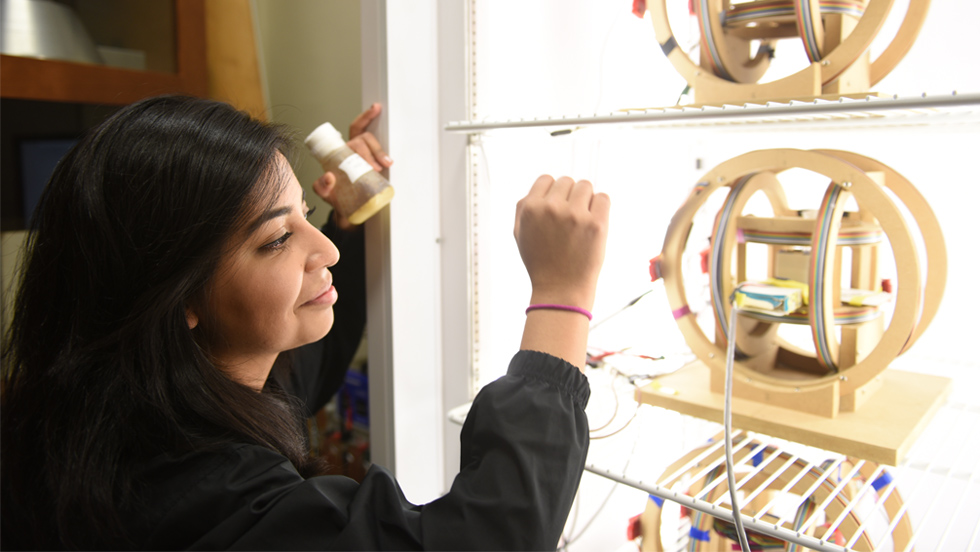
Physics majors at Adelphi no longer just solve problems on a whiteboard—they build their own solutions from scratch.
A new sophomore physics lab course taught by Matthew Wright, PhD, professor and chair of the physics department, puts students in charge of ambitious, hands-on projects that introduce them to the kind of work they might do in their careers as physicists.
“This class is innovative because it turns a physics lab into a real R&D shop,” said Dr. Wright, whose annual Cosmic Pathways conference treats college and high school students to a day of presentations, panels and workshops on the many exciting career paths for physics majors.
“Students don’t follow recipes,” he continued. “They invent their own projects, debug unpredictable problems, and learn to think like working scientists and engineers.”
Preparing students for physics careers
Student chose projects—building everything from a leaf blower-powered hoverboard and 3D‑printed drones to EKG devices and rockets—then spent the semester designing and debugging them. Students also had to write a proposal and budget for their project and get approval from Dr. Wright. This gives them experience in grant writing and technical writing.
The lab grew out of a multiyear effort led by Sean Bentley, PhD, associate professor of physics, to redesign the physics curriculum based on feedback from an industry advisory board. Employers told Adelphi they needed graduates who could do more than recite formulas; they wanted people who can debug complex systems, use lab instruments confidently, program computers, and solve messy, open‑ended problems.
The result is a three‑year lab sequence: an introductory first‑year lab to learn tools and basics, this open‑ended sophomore lab, and a more advanced senior quantum lab.
A Physics Major Builds Her Own Hoverboard in the Lab
Physics major Carolina Guekjian designed and built a hoverboard powered by a leaf blower.
“I wanted to do something cool, unusual and futuristic, something you cannot go out and buy,” she said. She used airflow and pressure calculations to figure out how much air she would need to lift to the board, how wide to make the board, how big to make the vents to lift the board.
“You can use these equations to come up with a theoretical idea of how your project will work,” Guekjian explained, “but the theory isn’t always exact due to real world conditions, so I had to alter it to make sure it works perfectly.”
There were problems, of course. Initially she thought she would use magnets in her project. “I ended up ruling them out because it was just going to be a fire hazard,” she says. “So I landed on using a leaf blower instead.” A battery connector failed near the end of her project, she said, which she still needs to fix. But her hoverboard hovers and can be steered left and right, so she counts her project as a success.
Guekjian said she spent 10 hours a week on her project, including lab sessions and time at the machine shop. Her efforts worked and she had a working hoverboard by the end of the class. “I learned that being in a lab and making a project is about failing and overcoming the failure until you get it right,” she said. She believes the skills she learned in the lab will help her pursue her dream of going into physics research in quantum optics.
“The ideas tend to be pretty simple, but the hard part is debugging and fixing and trying to figure out what all the little problems are and overcoming them,” said Dr. Wright, who wrote about Guekjian’s project in his Cosmic Pathways blog. That unpredictability turns each class meeting into improvisation, with the instructor moving from bench to bench to help students.
“It’s like being the orchestra conductor,” he said. “I never know what they’ll need help with, and that makes it fun and challenging for all of us.”
@wrightphyshop First test run of the hoverboard. We fried one of the propellers so we might be done. #physics #students #hoverboard #iteachphysics ♬ original sound – Damien Hebbard456
Physics for Sustainability: Creating Energy From Foot Traffic
Physics major Braden Patterson used the sophomore project lab to design a floor tile that generates electricity when someone steps on it. His invention, which Dr. Wright featured in his Cosmic Pathways blog, used a magnet spinning inside a coil to generate an electrical current that can power small devices like an LED light. The broader idea is to harvest energy from everyday foot traffic, he says.
“The lab and my project gave me a way to connect my coursework to the real world,” Patterson said. “In Physics I and II we learned the equations on paper, but this project let me build something from scratch and actually see those calculations come to life.”
Patterson said the skills he learned in the lab will help him reach his career goal. He’d like to work on electric motors for car companies and is also interested in nuclear energy production.
@wrightphyshop Beautiful teaching moment
Lab Course as a Career Testing Ground
“Dr. Wright is really fun and incredibly supportive,” Patterson said. “He explains things in a way that makes sense, and he’s always available for questions. With him, I never feel stressed about asking for help. He just genuinely cares about his students.”
Guekjian agrees. “Dr. Wright is patient and he’s helpful,” she said. “He really likes it when students learn, and he wants to do everything he can to help you learn the material.”
The lab is designed to push every student out of their comfort zone. Each of the 15 students must confront and overcome obstacles in their projects. “Every student in the class had to overcome major issues with their project, and that really leads to learning, and it leads to professional growth,” Dr. Wright said.
Dr. Wright also explained that the course could not have been created without the support of Professor Christoper Saucedo and Chris Stahley ’16, head studio technician, of Adelphi’s art department. “Professor Saucedo has built a really nice machine and wood shop and has made it available to the physics students,” Dr. Wright said. “When our students needed to prototype something, they’d go there and Chris Stahley would help them put it together.”
For many students, the class doubles as a career testing ground. About a third of Adelphi physics majors go into engineering, another third into traditional physics paths, and the rest into fields like teaching or technology. By choosing their own projects, students explore what they might want to do after graduation.
They also discover how powerful applied physics can be. “Physics is a platform for doing just about anything,” Dr. Wright said.