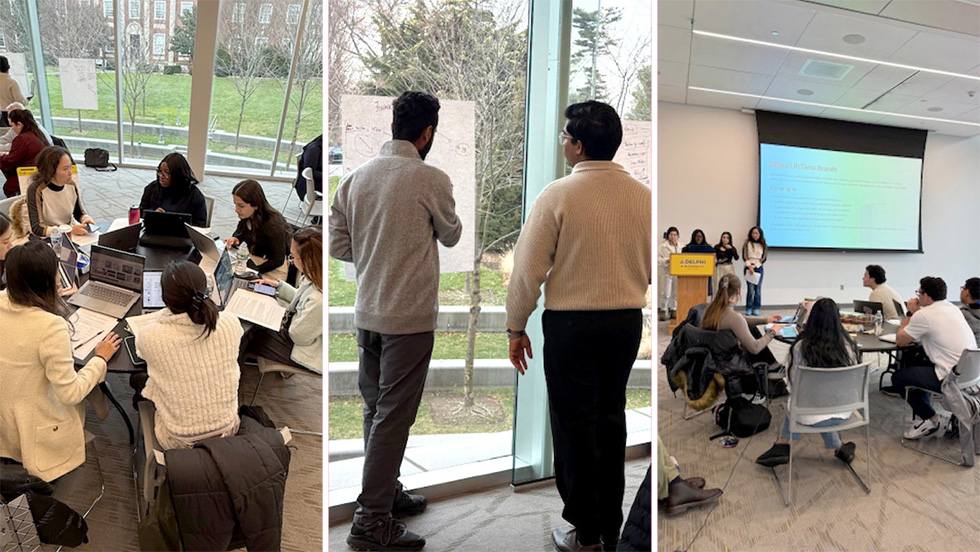
Intensive sessions give MBA students hands-on experience with negotiation, teamwork and problem-solving—the skills employers look for in business school graduates.
From 8:00 a.m. to 3:00 p.m., Sanjay Kumar analyzed a local company’s financial crisis, debated supply chain strategies with his team and learned to negotiate under pressure. The experience uncovered the strengths and weaknesses he needed to hone to succeed in business.
Kumar was one of the 41 students in Adelphi’s Flex MBA Program who attended the most recent Problem-Solving Day on December 6, 2025. Occurring twice per semester, these intensive sessions are required for all MBA students, and were created in response to feedback from the business community. “Businesses are looking for students who can come in not just knowing theory but knowing how to problem-solve,” says Raghida Abdallah Yassine, PhD, assistant professor of management and academic director of MBA programs in the Robert B. Willumstad School of Business, who co-led the most recent Problem-Solving Day alongside Michael O’Donnell, clinical assistant professor.
Creating a Program That Solves Real-World Business Challenges
When Problem-Solving Days began in early 2025, students worked with generic case studies and were asked to brainstorm solutions. But Dr. Yassine recently began collaborating with companies that were willing to share real-world challenges. The problem she chose for December 6 came from a local business struggling to stay afloat after tariffs on imports from China made their products too expensive to sell.
That morning, Dr. Yassine and O’Donnell divided the students into teams of five before presenting the issue they needed to solve. “Everybody sitting at the table is coming from a different specialization or has taken different types of courses, but they come together to solve a problem based on the knowledge they’ve acquired so far,” Dr. Yassine says. For Kumar, a business analytics major, this meant collaborating with classmates specializing in finance, marketing and other areas.
During the first half of the day, teams came up with a solution to the problem. For Kumar, the morning’s work revealed how interconnected his MBA courses were—he had to apply finance, supply chain management and marketing knowledge simultaneously, not in isolated courses. Kumar’s team divided the work by major and began researching which countries offered the best options for relocating the company’s supply chain. They had disagreements along the way—such as debating the merits of potential countries—but they didn’t outright refuse any idea. Instead, they asked teammates to justify their positions. “We negotiated everything when trying to find a solution,” Kumar says. This helped the team find weaknesses in their solutions they’d initially missed.
Dr. Yassine and O’Donnell were on hand to provide feedback throughout the morning. “That’s why we have two instructors per Problem-Solving Day, because we want the students to hear feedback from two different perspectives,” Dr. Yassine notes.
Teams had developed their recommendations by early afternoon. Then came the negotiation phase: Teams had to convince a consulting firm (a role played by other teams) to adopt their solution, which helped students practice the soft skills required in the workplace. “One of my teammates was very experienced and had been working in a firm for 20 to 25 years,” Kumar says. Watching him negotiate and maintain composure during cross-questioning, even when the team didn’t have an immediate answer, taught Kumar how to answer questions without becoming reactive.
He also learned that successful negotiation requires giving the other party room to speak. “If they’re interested in your idea, that’s why they’re asking questions,” Kumar explains. He also discovered the importance of having a backup plan. “If the consulting firm disagrees with your idea and you don’t have a backup plan, you’ll be blank,” he says.
What Students Gain from Immersion in Problem-Solving
Overall, the Problem-Solving Day gave Kumar a better understanding of the skills employers are looking for, such as negotiation and team building. It also gave him insights into his own strengths and weaknesses—while strong in finance, his presentation skills needed improvement. This discovery led him to register for classes to build his presentation abilities. “It’s not just about getting your degree, it’s about getting the skills you need,” Kumar says.
For students attending future Problem-Solving Days, Kumar recommends participating fully. “Don’t be the person standing to the side,” he says.
Dr. Yassine agrees: “Come with an open mind and be prepared to use previous knowledge,” she says. “You’re going to be learning a lot. That’s what Problem-Solving Days are there for, to make sure you’re workplace ready.”
Starting in Fall 2026, Adelphi’s Flex MBA will be offered in our new Manhattan Center, located near Grand Central Station, in addition to our Garden City campus.