Chemistry Research
At Adelphi University, chemistry research empowers students to work closely with faculty on cutting-edge projects.
As a chemistry student at Adelphi University, research is foundational to your academic experience. From your first year onward, you will have the opportunity to explore, innovate and make new discoveries while working alongside accomplished faculty mentors.
Whether your interests lie in organic synthesis, biochemistry, materials science, analytical chemistry or physical chemistry, you will apply classroom knowledge to real scientific questions using modern instrumentation in state-of-the-art laboratories.
To receive credit for research:
- Interview faculty during their first semester
- Join a research group as early as freshman year
- Select a permanent research group by the end of sophomore year
- Register for research credits with faculty approval
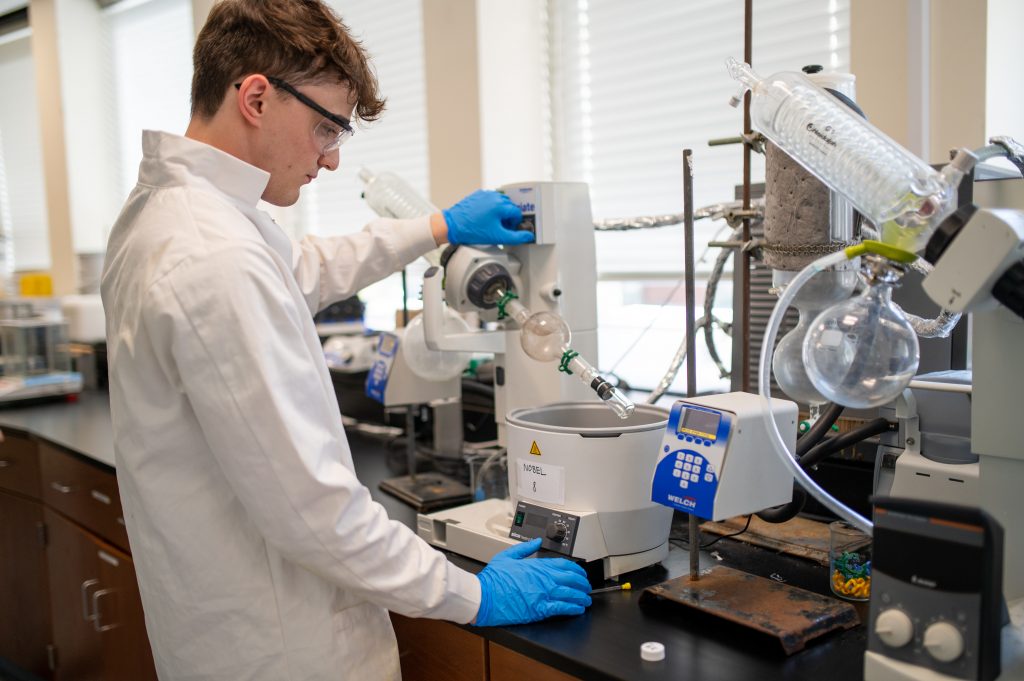
Undergraduate chemistry students have the opportunity to engage in guided research in the laboratory or in the field under faculty supervision.
Whether completing a capstone project, pursuing honors, or gaining research experience, the Adelphi SPARK Center supports students with project planning, mentorship connections, and preparation for presentations.
Interdisciplinary Connections
Chemistry is integral to scientific discovery, and our department actively collaborates across disciplines.
- Collaborative Research: We work with departments such as biology, neuroscience, physics, and education, fostering a multidisciplinary approach.
- Diverse Coursework: Our courses cover topics like forensic science, environmental chemistry, quantum mechanics, and nanotechnology, broadening students’ perspectives.
Research Seminars and Professional Development
Small class sizes allow for close mentorship and meaningful faculty interaction. Chemistry majors participate in a weekly seminar, where students:
- Present research findings
- Develop résumés and cover letters
- Learn how to write abstracts and read scientific literature
- Discuss internships, grants and fellowships
Conferences and Events
Chemistry students are strongly encouraged and financially supported to present their work at regional and national meetings, including the American Chemical Society conferences. Opportunities include:
- Undergraduate research stipends and fellowships
- Travel support for conferences
- The Landesberg Family Fellowship—an eight-week summer research award providing up to $5,000 to support full-time research with a faculty mentor.
Students also present their findings at Adelphi’s annual Scholarship and Creative Works Conference and regional undergraduate symposia.
Faculty Research and Areas of Focus
Working across all five divisions of chemistry—organic, inorganic, physical, analytical and biochemistry—our chemistry students collaborate closely with faculty whose research spans diverse and innovative fields.
Michael Lueckheide, PhD specializes in biochemistry, physical chemistry and polymer science. His research focuses on the synthesis and characterization of biomaterials, including the design of amino acid sequences that target pathogens and polysoap polymers that self-assemble into drug delivery systems. His laboratory investigates molecular self-assembly to develop delivery vehicles for chemotherapeutics and nucleic acids using surfactant-based systems and statistical copolymers.
Brian J. Stockman, PhD specializes in AI-guided protein design and biotechnology. His research integrates computational and experimental approaches to design and visualize novel proteins, express them in E. coli, and purify and characterize them using FPLC and other biochemical methods. NSF-funded work in his lab uses these approaches to investigate the origins of biological energy, with the goal of reconstructing prebiotic amino acid sequences in electron transfer peptides and proteins.
Justyna Widera-Kalinowska, PhD focuses on the synthesis of novel composite materials, alternative energy sources, environmental remediation, biochemical sensors, materials science, photoelectrochemistry and photocatalysis.
Melissa A. Van Alstine-Parris, PhD specializes in medicinal chemistry and has a strong interest in the scholarship of teaching and learning (SOTL). Her current research involves synthesizing small molecules that inhibit a nucleoside ribohydrolase as a potential treatment for trichomoniasis.
Daniel Silverio, PhD works in synthetic organic chemistry and chemical education research. His lab develops new methods and reagents for organic synthesis, with a focus on hypervalent iodide soecies and heterocycles. In the classroom, he studies how students learn organic chemistry, particularly their representational competency and understanding of reaction mechanisms.
I. F. Dempsey Hyatt, PhD specializes in hypervalent iodine chemistry, with research interests in molecular orbital theory, reaction design and mechanisms, the rapid synthesis of complex molecules for drug design, and superconducting materials. His research group offers undergraduates hands-on experience in advanced synthetic methods, instrumentation, and research spanning organic and inorganic chemistry.