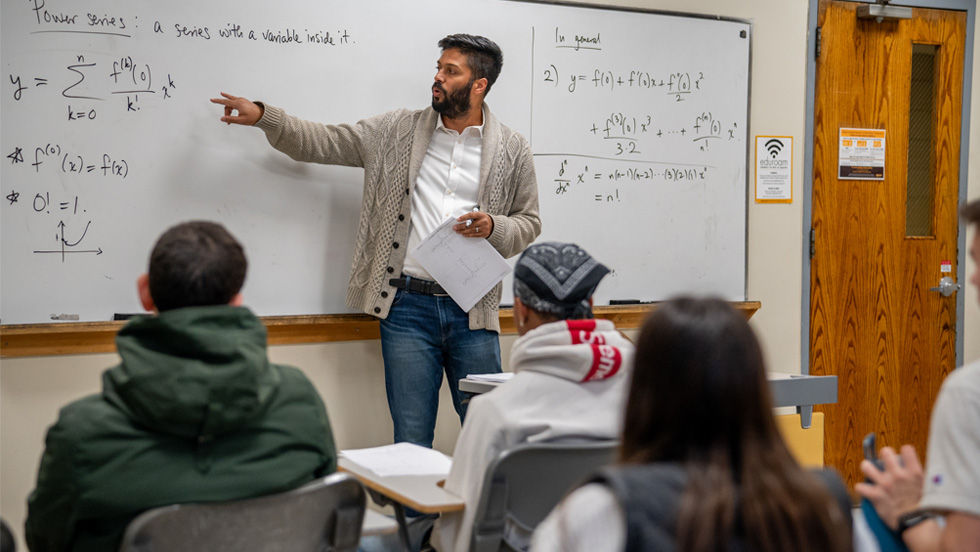
Launched at the beginning of this academic year on Adelphi’s main campus in Garden City, New York, the cutting-edge graduate program is expanding to the new Manhattan Center this fall to give tech professionals in New York City career-advancing knowledge and skills.
Adelphi’s innovative MS in Artificial Intelligence and Machine Learning program is coming to the new, state-of-the-art Manhattan Center in Fall 2026, expanding opportunities for students to advance their careers in tech, engineering, and other in-demand fields impacted by AI.
“A lot of people are looking to upskill and understand how their professionalization can remain relevant in an AI agent workforce,” said Anil Venkatesh, PhD, director of the program and associate professor of mathematics and computer science. “We wanted to offer this program at a place that would be convenient for working professionals, and the Manhattan Center made a lot of sense.”
By expanding this program to the new state-of-the-art facility, located just steps from Grand Central Station at Fifth Avenue and 44th Street, Adelphi is making it even easier for students to develop these career-defining skills, network with other forward thinkers, and explore job opportunities.
“We are expecting to see a lot of professionals from diverse job backgrounds who will bring some really interesting perspectives,” Dr. Venkatesh said. “That will only increase the overall engagement of courses.”
The MS in AI and Machine Learning is just one of the programs in the first wave of 13 graduate and professional offerings coming to the Manhattan Center. Students can choose from degree and certificate programs in business, education, healthcare, psychology, and social work.
A world of career options
The AI program, which launched this year on Adelphi’s Garden City campus, is designed to prepare the first generation of AI professionals for advanced careers in technology, government, healthcare, financial services, logistics, e-commerce, and virtually any other field. Current job titles include AI engineer, machine learning engineer, data scientist, data analyst, and business analyst.
Courses in the master’s degree program combine practical, real-world learning experiences with deep theoretical knowledge that can be applied to AI models—not just now, but as technology evolves.
“Ultimately, the theory of AI is not something that was just invented,” Dr. Venkatesh said. “It has existed for quite some time. And understanding that theory is going to make it so that you can plug and play with whatever new model or paradigm comes along.”
The program is also built to adapt to new AI careers and applications as they continue to emerge. The program’s seminar, for example, is updated every year with new tools and input from speakers currently working in the industry. And Dr. Venkatesh’s course on artificial intelligence and machine learning algorithms is consistently refreshed with the latest cutting-edge algorithms and best engineering practices.
As Dr. Venkatesh said, “We’re both staying up-to-date with contemporary discoveries and innovations and incorporating foundational math and statistics that will be useful no matter where the industry goes.”
Customizing AI education for different professions
AI isn’t only impacting technology companies and engineering careers. It’s being applied across sectors, including government, healthcare, and financial services.
“We’ve had students who’ve worked in programming-heavy disciplines,” Dr. Venkatesh said. “But we also expect to see folks with backgrounds in statistics as it relates to life sciences and healthcare because AI tools are tremendously valuable in those disciplines.”
To that end, Dr. Venkatesh makes a pointed effort to customize his Artificial Intelligence and Machine Learning Algorithms course for students’ professional goals.
“When I assign projects, I explicitly invite students to counter-propose a different topic if there’s something specifically suited to their particular professionalization,” he said. “As long as it’s comparably challenging and relevant to the course, I accept the proposal.”
Students responded enthusiastically to the invitation, proposing and carrying out research projects in healthcare, bioinformatics, sports analytics, financial services, and business analytics.
Thinking ahead to the fall, Dr. Venkatesh looks forward to welcoming the program’s first cohort to the Manhattan Center and continuing to teach as this exciting field evolves.
“The other professors and I who put this program together really love teaching it,” he said. “We’re excited by the format of the course and the type of student that we’re orienting toward. This is some of the most fun teaching we’ve had in a long time.”