PhD in Learning Sciences
In a changing world, how we learn is also changing. With this PhD in Learning Sciences, you will research and design the future of education for schools, museums, libraries, workspaces and the digital realm.
Why Study the Learning Sciences?
- Today, learning is happening everywhere—not just in schools or universities. Become an expert in the latest theories of learning for almost any discipline or sector.
- Investigate when, where, how and why people learn.
- Prepare for a career as a research scientist, developer or instructional designer across industries, both for-profit and nonprofit.
- Design cutting-edge learning environments in order to shape your community, your chosen field and the world.
- Develop critical skills for investigating pressing social, cultural and economic concerns that influence learning.
- Work with artificial intelligence, XR technology, open data and other innovations that challenge us to consider learning with fresh eyes.
Why Get a Learning Sciences Degree at Adelphi University in New York?
Learning sciences is a rapidly growing field dedicated to studying how learning happens. This doctoral program in learning sciences is an immersive learning laboratory, offering more than just a degree. You will conduct cutting-edge work in our state-of-the-art Makerspace at Adelphi’s new Manhattan Center in the heart of New York City. This facility blends classroom and out-of-class experiences, emphasizing experimentation, play, fantasy and design to envision new ways of thinking and learning. Through our Learning Sciences Workshop courses, you’ll undertake exciting research projects alongside supportive faculty, exploring the many dimensions of learning. You will integrate your existing expertise with the latest innovations in learning theory, design and technology to become a leader in the field.
We utilize a flexible, hybrid course structure so you can continue to work while joining a vibrant intellectual community.
What Makes Our Learning Sciences PhD Program Distinctive?
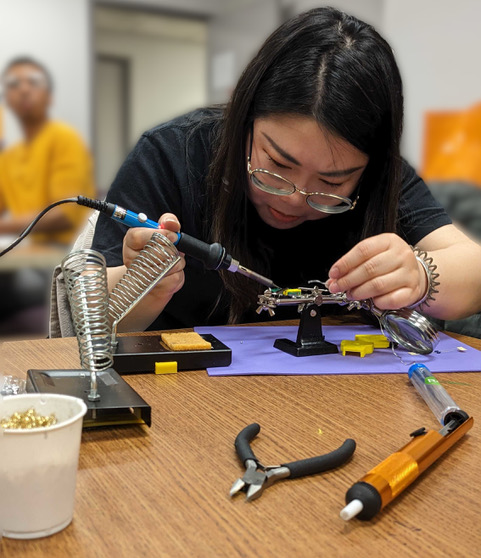
- Location: Starting in Fall 2026, this program will also be offered in our new Manhattan Center with state-of-the-art classrooms, libraries and technology facilities. New York City will be your classroom.
- Flexible Schedules: You will be able to continue working full or part time because of our hybrid and part-time study options.
- Financial Aid: All applicants will automatically be considered for financial aid opportunities, including scholarships, fellowships, graduate research assistantships and university teaching.
- Innovative Faculty: Our faculty engage in interdisciplinary projects that merge arts, humanities, and the social and physical sciences. They have earned grants from the National Science Foundation, The Spencer Foundation, the Mozilla Foundation and other top research organizations.
- Partnerships: You will engage with Adelphi’s many community partners and alumni across many fields: arts and culture, business, nonprofits and social services, and data and technology in the world’s most vibrant city.
- Hands-On Research: Our coursework is designed to engage students in hands-on research alongside distinguished faculty from their very first semester.
- Community: Our scholars affiliate with an active intellectual community at MIXI Institute for STEM and the Imagination.
- Scope and Reach: We support the study of learning anywhere it might happen, including museums, schools, communities, digital spaces and international sites.
Adelphi’s Learning Sciences program will help you understand, critique and construct educational experiences in our contemporary communities. Using cutting-edge theories and careful, rigorous studies, our program will help students design modern, effective and equitable learning environments.
 Suraj Uttamchandani, PhD
Assistant Professor and Learning Sciences Program Director
Suraj Uttamchandani, PhD
Assistant Professor and Learning Sciences Program Director
What Can You Do With a Learning Sciences PhD?: Business Leaders, Consultants, Researchers
The PhD in Learning Sciences qualifies you to help shape the vision and design of learning initiatives across many industries. You can become a learning consultant or learning specialist in any of the following fields:
- Universities or colleges
- Instructional design (in person and online)
- School districts
- Tech companies (especially in the AI industry)
- Curriculum and assessment groups
- Educational publishing companies
- Government agencies
- Nonprofits
- Community organizations
- Museums and libraries
- Toy companies
Program Info
Application Requirements
We accept applications on a rolling basis throughout the year, with a priority deadline of March 1 and a final application deadline of July 15. Students begin the PhD in Learning Sciences program in the Fall semester.
Applicants should complete a master’s degree before matriculation, although exceptional students without one may be provisionally admitted. Our students come from a wide range of backgrounds, including academic work in psychology, education, social sciences and STEM; career work in museums, community programs, libraries and government agencies; and experience with UX design, software engineering or other technology and design fields.
Note that students who do not enter with a master’s degree are required to complete an additional 15 credits of coursework (for a total of 60 credits). In consultation with an adviser, these students may strategically choose these courses in order to meet the requirements for an MA in Educational Technology (which will require 68 total credits), or may choose elective courses from across the University.
The PhD in Learning Sciences is a residential program that requires in-person attendance at some classes and meetings on our Manhattan Center. Classes are often scheduled in the evenings to accommodate students who work full time; please consult with the program director if you have any questions.
Applicants should submit the following materials:
- Online graduate application and $60 application fee
- A current résumé or CV
- Final transcript stating bachelor’s degree from an accredited four-year institution
- Final or in-progress transcript stating master’s degree from an accredited institution
- Personal statement
- Scholarly writing sample
- Letters of recommendation
- In addition to the requirements above, non-native-speaking international students must submit results from an English language exam. Adelphi University accepts official score reports including TOEFL (80), IELTS (6.5), MET, Language Cert or Duolingo English Test (minimum 110).
- Course-by-course evaluation: All graduate applicants with undergraduate-level work completed outside of the United States will be required to send a course-by-course evaluation of their academic work prepared by a NACES member organization. Adelphi recommends you use The Evaluation Company (TEC) or IEE (discount provided for Adelphi applicants), ECE, or WES, but any NACES member evaluation would be acceptable.
Your current résumé or CV should include your scholarly background, including any relevant educational experiences, publications, projects, advanced coursework, honors and awards, and/or work or volunteer experience.
Transcripts should list the name of the university, a list of courses you have taken or are taking at the university, and the grades you received in these courses. You should send a transcript for any university from which you have earned college credit, including both undergraduate and graduate degrees.
Please submit a scholarly writing sample of work you have previously written. This could be a master’s thesis or final course paper. The sample should demonstrate your ability to read and write academically at the pre-doctoral level. Your sample should be between 10 and 20 double-spaced pages. Extracts from longer works are accepted.
Please submit a personal statement describing your relevant past experiences and goals for pursuing doctoral study in the learning sciences, in a focused essay (no more than 800 words).
For a doctoral program, your personal statement serves to describe the research you hope to do and explain why you think the Adelphi University learning sciences program is a good place for you to do it. Of course, any ideas you discuss here will likely change as you progress through the program; however, stating your ideas helps us see what kinds of projects interest you and how they fit with the work we do here.
In your statement, you may choose to reflect on some of these questions:
- What are some meaningful experiences with learning and learning design from your past, and how have they shaped your current thinking about learning and design?
- What specific expertise do you bring to the program?
- How have your prior experiences prepared you to succeed in doctoral study?
- What are your overall research interests, and why?
Sociologist Eve Ewing, EdD, provides a guide to writing such statements that may be helpful for you, although we by no means require this format
Submit two letters of reference. Letters of reference should come from professors with whom you have worked closely who can speak to your scholarly potential. These are often advisers, professors you have conducted research or independent study alongside, or professors in whose courses you have done work you are very proud of. At least one of your letters should be an academic reference (i.e., from a professor). If you think it is useful, one of your two letters can come from someone who has supervised you in another capacity, such as a principal or director; but we suggest you only do this if the work they are speaking to is relevant to the learning sciences.
Letters will be submitted confidentially; submit writers’ contact information in the application.
We suggest you provide your letter writers with all the information you are including in this application. It is usually good to give professors about one month’s notice to submit. It is generally appropriate to send reminders to letter writers shortly before letters are due.
You may choose to include with your application any other material that you think the admissions committee should review, though not including optional materials won’t count against you.. Optional materials may include a design portfolio, a second writing sample or anything else you think will help us better understand your background as it relates to the doctoral degree.
If you are admitted, you will receive a provisional adviser. You will form a program of studies committee after your first semester, then a dissertation committee once you complete the qualifying process.
Understanding Costs and Savings
Learn about the costs you can expect, and discover how scholarships, grants and financial aid packages can put an Adelphi education within reach.
FAQs: Learning Science PhD Program
Our learning sciences program focuses on researching and designing learning in the contemporary world. For us, learning happens everywhere. Our degree empowers you to design innovative learning experiences—and evaluate their effectiveness—in a variety of settings, including schools, museums, libraries, digital spaces and community organizations. With this in mind, our learning sciences PhD program is designed as a learning laboratory, offering a blend of both classroom and out-of-class experiences to ensure that students are equipped to become leaders in their chosen fields.
Our faculty are interested in working with students in a wide variety of settings and exploring a wide variety of research interests connected to learning and modern life. Our faculty’s specialization areas include but are not limited to: Place-Based and Place-Conscious Learning and Design; STEAM (STEM + the Arts) Learning and Making; Educational Technologies and Digital Literacies; and Critical and Political Learning.
Our learning sciences PhD program includes coursework that leads to your independent dissertation research. You will take 13 classes in areas across the learning sciences, embodied learning, adolescent development, critical technology studies and research methodologies. As part of your coursework, you’ll participate in Learning Sciences Workshop classes in which you will engage directly in applied research and design side by side with our faculty. As you finish your coursework, you’ll begin your independent dissertation research on a topic of your choosing under the supervision of a learning sciences faculty member.
Absolutely! Our classes take place in the evenings and employ a hybrid modality, with alternating weeks in person, so that you can continue to work while pursuing your degree. Many of our students complete the degree part time.
All doctoral program applicants are considered for Adelphi’s standard financial aid opportunities that include scholarships, fellowships, graduate research assistantships and university teaching. Within the learning sciences PhD program, specifically, there are a handful of opportunities to teach or work as a research assistant that provide tuition remission. If you are interested in any of these opportunities, speak with the program director for more information.
Awards & Recognition