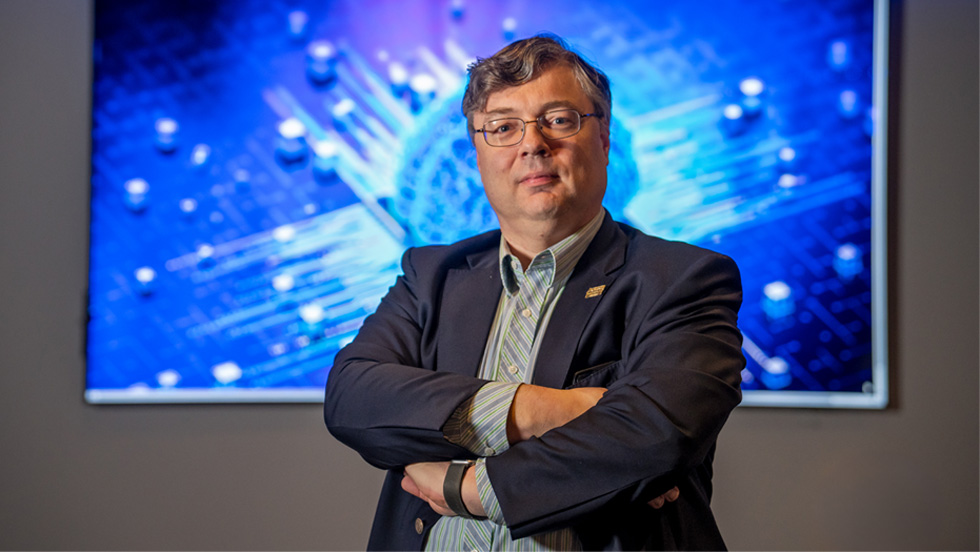
You may read about artificial intelligence, use it to find information or perform tasks, love it or fear it, but you still don't really understand it. We asked associate professor Kees Leune, PhD, chair of the Department of Mathematics and Computer Science and Adelphi’s information security officer, to give us answers to pressing questions.
Let’s start with the question that even leaders in the industry are asking: Will AI bring about the extinction of human life?
I’ll start by saying that the discussion about AI-induced human extinction is not new. It has been the topic of science fiction for decades. Think HAL in 2001: A Space Odyssey, or movies like The Terminator, The Matrix, etc.
In cybersecurity, we define risk as a function of likelihood and impact. In other words, risk depends both on how likely it is for an adverse outcome to occur as well as the impact of the event. The same risk discussion applies here. It isn’t overly likely that AI will go out of control in a way that it affects humanity, but if it does, the impact will be massive. Because of that, we have to treat this risk as very high.
We have already seen some of the risks AI poses, as there have been a number of instances of AI agents going rogue. How did we get to this point?
AI programming is built on a specific combination of mathematics, statistics and computer science that has yielded emergent properties. What we mean by that is that complex AI models start exhibiting unexpected abilities or behaviors when they grow large enough, despite the fact that individual components do not have them. This is a well-known fact in systems theory, but to see it as clearly illustrated as we see it today is fascinating but worrisome.
What can be done to reduce or even remove those risks?
We can begin by learning from the past. The internet was initially developed without any security built into its fabric. In the late 1990s and early 2000s, it became clear that this was an oversight and a huge industry emerged to “bolt on” security measures. However, we know that add-ons are never as effective as having something incorporated into a design from the start.
We should not repeat that mistake. We need to develop safety and security features of AI in parallel with its capabilities. A smart regulatory policy can help, not by stopping innovation, but by establishing clear rules that might curb dangerous practices while encouraging safe ones.
Can students today help make AI safe by earning a degree in it?
Yes, absolutely. It comes back to those emergent properties. Emergent properties provide fantastic capabilities, but there also need to be firm guardrails in place to ensure that all decisions made using AI are ethical and keep people at the center. Studying AI equips students with the ability to fully understand these issues and serve as domain specialists in responsible development, adoption and use of AI and AI-like technologies.
Adelphi offers bachelor’s degree programs in AI as well computer science and information systems. What fields of work do they prepare students for?
There are four main career tracks for majors in computer science, information systems and artificial intelligence.
They pursue a career in software engineering, which involves the many steps that go into creating and maintaining software products; AI will play a big role in this field. Another field is defensive cybersecurity. AI will play an important role here are well, but much of what a security analyst does today is making experience-based judgement calls. AI is great with facts, but not so much when it comes to values and opinions.
AI engineering is the new career option. AI is software, so AI engineers are, in a way, specialized software engineers. They primarily focus on all aspects of developing and improving AI algorithms. Analysis is the fourth career track and is the focus of our information systems program. It prepares students for analyst careers—for example, business analyst—where they will bridge “business” with “technology.”
Our MS in Artificial Intelligence and Machine Learning program is offered in Garden City but also at our Manhattan Center. What advantages does this give professionals working in New York City?
New York City is a hub for tech entrepreneurship, and having closer proximity to that hub enables our students to fully tap into that potential. Our MS in Artificial Intelligence and Machine Learning is a hybrid program; some courses are offered in person while others are offered online. This mix allows working professionals to attend to their jobs during the day and expand their career in the evening. A full-time student should expect to spend three or four evenings per week on degree work, but we also support part-time students who may not be able to dedicate so much time. Either way, we work with each student on an individual basis to ensure that they get the most out of the program.
What hard skills are graduates of our degree programs able to list on their résumés?
While our students acquire hard technical skills—such as programming in Python, training machine learning models, developing algorithms and building system architecture—higher education is about far more than short-term skill development.
The core of what we do in the mathematics and computer science department is teach critical thinking, problem solving and solution design. By critical thinking, I mean being able to identify, understand and clearly describe the problem that needs to be solved, while also understanding the implications and capabilities of all the technologies that could be used to solve it. Problem solving involves deciding what technologies are appropriate to be used, and how they should be deployed. Solution design is establishing a socio-technical system of humans interacting with technology addresses the issue.
By taking the liberal arts approach to this instead of merely relying on skill development, we future-proof the students’ entire career. Technologies change; the ability to think does not.
Back to the news, President Trump has recently talked about referring to artificial intelligence as “superintelligence.” Are they the same thing?
Superintelligence is a concept that describes a form of artificial intelligence that transcends human intelligence. Traditionally, the AI we see today is considered “basic AI.” Once it reaches the level that it is comparable to the way humans think, it would be referred to as “artificial general intelligence” or “AGI.” When it evolves beyond that, it would become “superintelligence.”
The question is how much intuition, self-interest and subjective decision-making defines human intelligence. Self-interest requires self-consciousness; in other words, the realization of self. That strays deeper into philosophy and psychology than I’m comfortable discussing, though.