Physics Research
At Adelphi University, physics research gives students the chance to work closely with faculty on cutting-edge projects.
From your first year, you can explore areas like quantum optics, astrophysics, atomic physics, plasma science, and applied experimental physics. Students apply classroom learning to real-world problems while gaining technical skills and professional experience.
To receive credit for research:
- Interview faculty during your first semester
- Join a research group as early as your first year at Adelphi
- Select a permanent research group by the end of your sophomore year
- Register for research credits with faculty approval
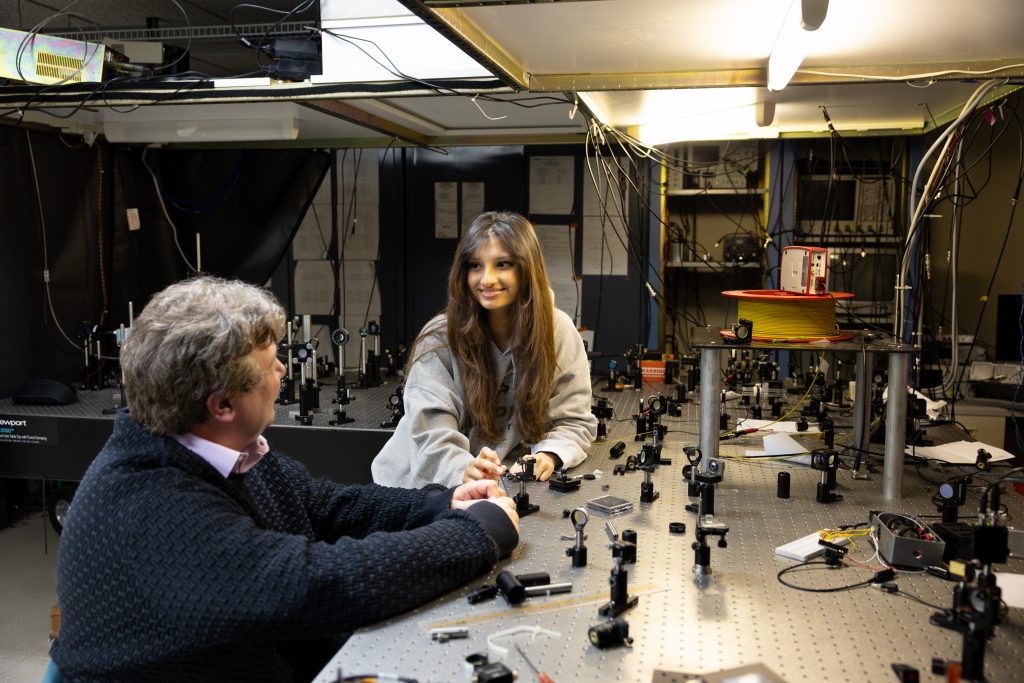
Physics students receive personalized mentorship and one-on-one guidance from faculty members.
Undergraduate students can engage in guided research alongside faculty mentors, gaining hands-on experience in projects that advance their technical and analytical skills. Students present their work at the Adelphi Scholarship and Creative Works Conference and may also participate in regional and national conferences.
Whether completing a capstone project, pursuing honors, or gaining research experience, students receive guidance through:
- SPARK Center: Support with project planning, mentorship connections, and presentation preparation for undergraduate projects
- Innovation Center: Opportunities for interdisciplinary, project-based research and exploration
Faculty Research and Areas of Focus
Kevin Liang, PhD focuses his research on imaging, developing new ways to capture and reproduce information from objects that may be small, distant or obscured. Supported by a recent $242,000 NSF grant, his work integrates geometrical, wave, nonlinear and quantum optical techniques to push the limits of image resolution. His research advances both the underlying physics and the technology behind imaging systems, with applications in astronomy, biomedical diagnostics and photography. By challenging traditional limits on resolution, his work contributes to next-generation sensing and measurement technologies.
Neda Naseri, PhD studies light–matter interactions at the nanoscale using computational simulations, focusing on how ultrafast lasers interact with materials in extreme conditions. Her research in nanophotonics examines how structured light can be used to modify and control materials with high precision. This work supports advancements in laser micromachining, photonic device design and next-generation manufacturing techniques, while also bridging physics with engineering applications.
Neda Naseri, PhD explores plasma physics through theory and advanced computational simulations, focusing on collisionless shocks, particle acceleration and laser–plasma interactions. Her research examines how charged particles and electromagnetic fields behave under extreme conditions similar to those found in astrophysical environments such as supernovae and space plasmas. She also investigates how high-intensity lasers interact with matter, contributing to understanding both fundamental physics and practical applications in energy and advanced materials.
Matthew Wright, PhD leads an atomic physics lab where lasers are used to explore and control quantum systems with high precision. His research focuses on using tailored light pulses to manipulate atoms and molecules, enabling new ways to probe and control quantum behavior. This work contributes to the broader field known as the second quantum revolution, where researchers are learning how to engineer quantum systems for practical use. Students gain hands-on experience working with laser-based experimental systems and learning how quantum phenomena are studied in the lab.
Sean Bentley, PhD investigates the properties of quantum entangled photons and their applications in sensing and information science. In 2026, he published three papers, including “Maximizing Bell Violations with Imperfect Entanglement” in the European Journal of Physics with two undergraduate co-authors, along with articles in Physics Education and Technology and Engineering Education.
Bryanne McDonough, PhD works with students to analyze large-scale simulations of galaxy formation and evolution. Her research explores how galaxies change over time, focusing on processes such as star formation, magnetic field development and the distribution of cosmic dust. Because many of these processes occur over extremely long timescales, computational simulations and data analysis are essential tools. She uses machine learning and high-performance computing to extract insights from complex datasets, preparing students for careers in data science, astrophysics and computational research.
Matthew Wright, PhD leads initiatives in physics education, outreach and community-building in addition to his research in atomic physics. His work includes developing programs and conferences that expand access to physics and support student engagement beyond the classroom. He focuses on creating meaningful learning experiences that connect foundational physics concepts with active research environments.
Sean Bentley, PhD is dedicated to mentoring undergraduate researchers and developing educational experiments and resources in quantum engineering for pre-college and undergraduate students. In 2026, he published “Teaching Entanglement: Overcoming Common Misconceptions” in Physics Education and “Quantum Engineering: A Comprehensive Pre-College Course” in Technology and Engineering Education.