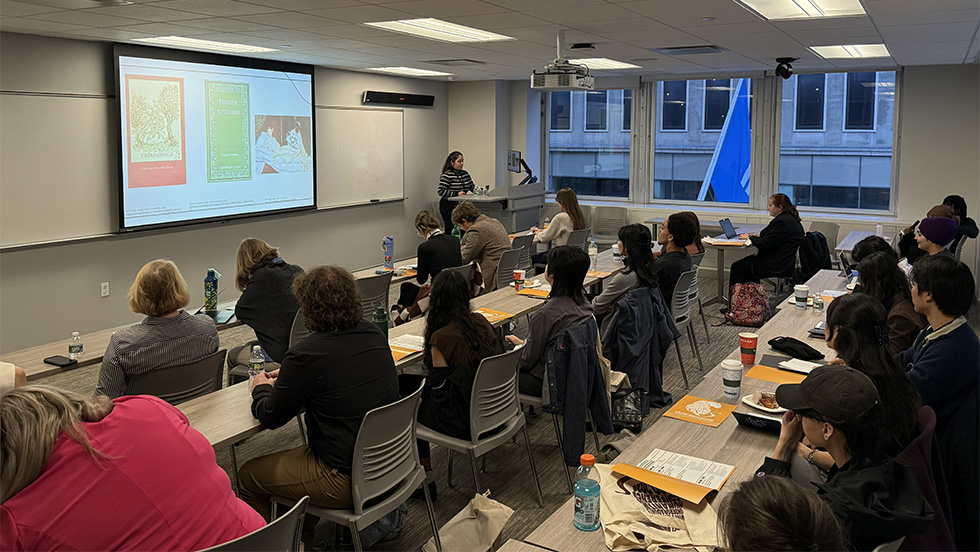
Twenty-five student scholars from 15 colleges and universities came to Adelphi's new Manhattan Center to argue that, in an age of intelligent machines, the humanities have never mattered more.
The machines may have been the subject, but the very human students were the ones doing the talking.
On November 20, undergraduates from Brown University, the University of Pennsylvania, Vassar College, Barnard College, Swarthmore College, Boston University and other campuses across the Northeast and mid-Atlantic joined Adelphi’s own students in converging on Adelphi’s new Manhattan Center at 529 Fifth Avenue. Their charge was to show that the humanities will not be a casualty of artificial intelligence, but, instead, its most significant counterweight.
The event was the inaugural Adelphi New York Undergraduate Humanities Conference, sponsored by the University’s SPARK Center for Undergraduate Research. In its first year, the conference drew 26 student presenters, eight of them from Adelphi, who spent the day exploring algorithms, dystopias, art, translation and what it means to be human, all interconnected within the theme “The Humanities in an Age of Intelligent Machines.”
“For many of us, the best part of the humanities is the sharing of ideas—the conversation,” said Louise Geddes, PhD, interim dean of the College of Arts and Sciences and professor of English, who was instrumental in creating the Adelphi New York Undergraduate Humanities Conference. “I wanted to offer undergraduates the opportunity to engage in the public humanities, showing the brilliant work that they are doing in their classes and having serious conversations about the place of the human in this technological era.”
OpenAI CEO Sam Altman has called the rise of AI a “gentle singularity.” By this, he meant that AI isn’t arriving in one sudden, earth-shattering moment, but as a series of technological advances that come gradually and incrementally, so they feel impressive but quickly fit into our “normal.” The conference’s organizers saw the implications of AI as something less than gentle: a world where machines appear to be thinking for us and where the human experience is minimized. The call for papers was a challenge for students to stake the humanities’ claim against being overtaken by nonhuman thought:
- How is the human constructed in the face of an increasingly technological world?
- How has history navigated these moments in which new technologies reorient the world, and how has it changed humanity’s ability to define itself?
- In what ways does literature or philosophy grapple with what it means to be a human (or a post- or nonhuman)?
- In an era of digital identity construction, who gets to be human—and who doesn’t?
- How does technology bring together communities that assert or redefine humanity? How might the humanities work with or within technological advances to meaningful ends?
At the conference, students answered from all corners of the humanities: literature, history, philosophy, cultural studies, political studies, communications and languages.
From Dystopia to the Mexican Revolution: A Day of Deep Thought
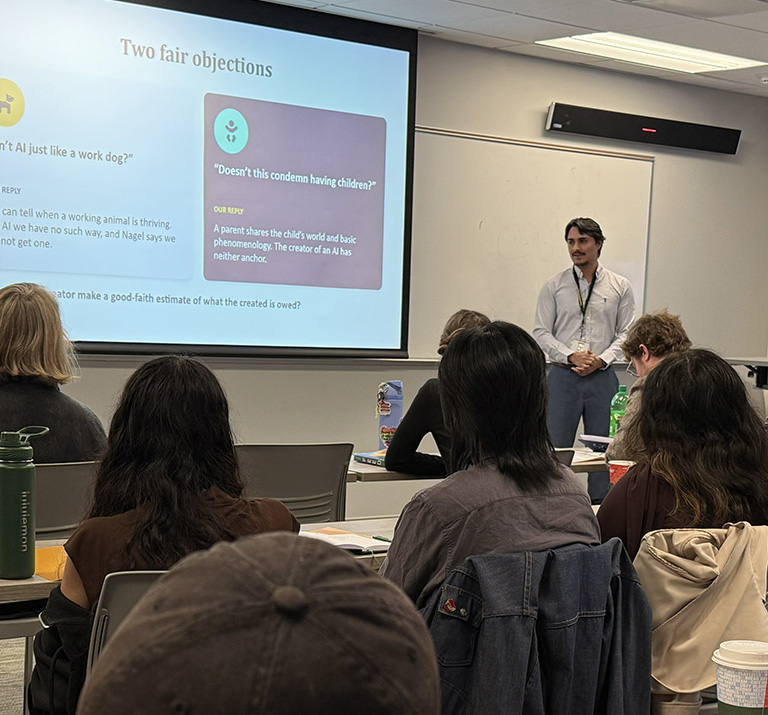
Vassar College undergraduate student Angel Garcia presented on the moral stakes of AI consciousness.
The morning session dived right into the big questions. In “Dispatches From Dystopia,” Vassar College’s Angel Garcia wrestled with the moral stakes of AI consciousness, while Stony Brook University’s Emily Mandracchia examined Kazuo Ishiguro’s novel Klara and the Sun for lessons on technocracy. Adelphi’s Elizabeth Gonzalez Portieles staged a head-to-head between an AI-generated literary interpretation and a human-written analysis, and Elizabeth Manton traced slavery, power and the birth of modern gynecology.
Students also presented counterpoints exploring the question of whether “to use or not to use” AI. Adelphi’s Arpan Josan sounded the alarm about ChatGPT’s threat to the creative writing process, and classmate Anthony LaFalce arrived with a title that said it all: “AI: Artificial Incompetence,” while Vassar’s Rylan Yichun took aim at “sentimental humanism” and Hofstra University’s Tori Globus countered that AI cannot be shut out of creative spaces.
Other presentations explored surveillance and psychoanalysis. Adelphi’s Samina Radia channeled Rousseau to critique AI’s “digital chains,” and Mackenzie Rutkowski examined the technology of execution through the lens of race and justice. Fordham’s Walker Harris told the story of Indigenous canoe-making as resistance to empire, and Morgan State University’s Karoline Ruhdorfer tracked what happens when a text travels from Māori to English to German by human hand versus algorithm.
The afternoon session made a compelling case that today’s tech anxieties have deep roots. In “Captured Pasts, Fractured Futures,” Swarthmore College’s Leia Immanuel explored naturalist Maria Sibylla Merian’s early modern insect prints; The New School’s Lola Page revisited John Woodman Higgins and the chivalric imagination of the American machine age; Adelphi’s Hannah Nisimov decoded the media agendas of the Mexican Revolution; and Barnard College’s Sekna Bazzi uncovered the environmental hazards facing Puerto Rican immigrants in 1910 New York City.
Finally, “Upset Relations” featured Adelphi’s Kayla Schaaff on feminist reading in the age of AI, Ursinus College’s Benjamin Warner on Irish artistry and national identity, and Montclair State’s Christopher Halstead on what early tales of artificial life teach about the ethics of creation.
Keynote: Inside “That Warehouse of Forms”
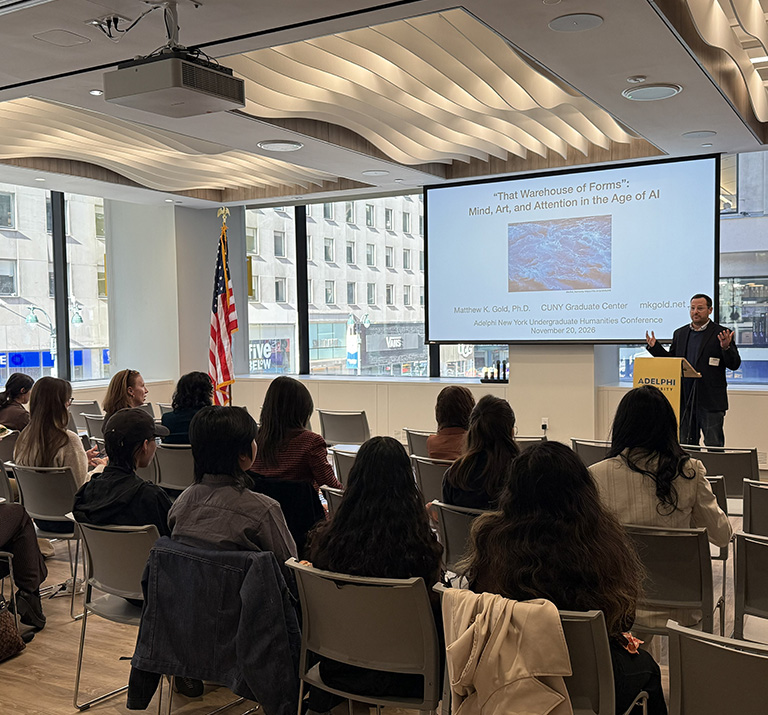
Matthew K. Gold, PhD, associate professor of English and digital humanities at The Graduate Center, CUNY, gave the keynote “That Warehouse of Forms: Mind, Art, and Attention in the Age of AI.”
For the plenary session, the spotlight turned to keynote speaker Matthew K. Gold, PhD, associate professor of English and digital humanities at The Graduate Center, CUNY, where he is adviser to the provost for digital initiatives, and where he directs the MA Program in Digital Humanities and the MS Program in Data Analysis and Visualization. He is also co-editor of the Debates in the Digital Humanities book series from the University of Minnesota Press.
In “That Warehouse of Forms: Mind, Art, and Attention in the Age of AI,” Dr. Gold pulled back the curtain on the technology behind AI itself through the lens of the digital humanities, exploring AI language models as storehouses of the shapes of human creation that merely imitate what we create without understanding its true meaning. He walked through how large language models build their knowledge bases, why that process shapes what they produce and how the world’s institutions, including colleges and universities, have adopted AI.
A Deeper Dive Into Adelphi Student Presentations
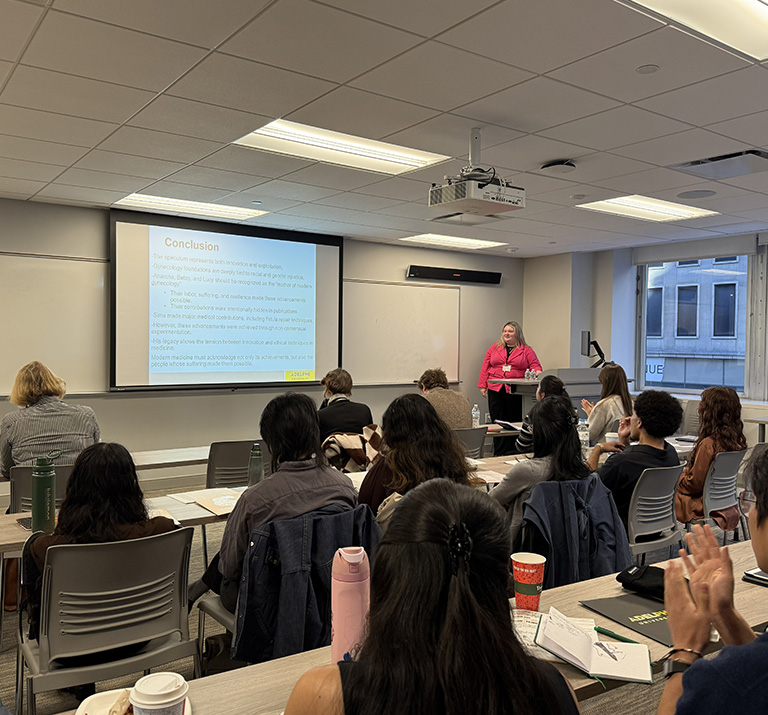
Adelphi history student Elizabeth Manton presented “Behind the Speculum: Slavery, Power, and the Birth of Modern Gynecology.”
Eight Adelphi students took the stage alongside peers from across the region. Read summaries of their presentations:
- Elizabeth Gonzalez Portieles, senior English and biology major: “Human vs Machine: Comparing an AI-Generated Literary Interpretation With a Human-Written Analysis.” Gonzalez Portieles compared her own reading of a vignette from Harryette Mullen’s Trimmings with one generated by ChatGPT. The AI drew on feminist ideas but missed the figurative and symbolic meanings central to Mullen’s work. Because AI cannot reason, Gonzalez Portieles argues, its interpretations are unoriginal and superficial, and they do not belong in the humanities.
- Elizabeth Manton, junior history major: “Behind the Speculum: Slavery, Power, and the Birth of Modern Gynecology.” Manton examines the history of modern gynecology through the development of the speculum and the controversial legacy of J. Marion Sims, MD, who was long regarded as the “father of American gynecology.” An instrument often presented as part of a routine medical checkup, the speculum has a troubling history rooted in slavery, racial and class hierarchy, and medical experimentation. By looking into the history of the speculum, this presentation connected past injustices and abuses to conversations about consent, trust and women’s healthcare of today.
- Arpan Josan, senior English major: “How the Creative Writing Process Is Being Threatened by the Increased Usage of ChatGPT.” Josan argues that ChatGPT is trading away the originality, authenticity and critical thinking at the heart of creative writing for a lighter workload. She drew on case studies including The Last Screenwriter, a film written entirely by AI, and Lena McDonald’s Darkhollow Academy, a novel that contains ChatGPT prompts.
- Anthony LaFalce, junior English major: “AI: Artificial Incompetence.” LaFalce says, “I have never willingly used AI for any educational or recreational purpose.” Turning to Gertrude Stein’s Tender Buttons, he argues that in “A Red Stamp,” Stein goes beyond describing a stamp to create art, something only the human mind can analyze.
- Samina Radia, senior political science major: “Man Is Born Free, and Everywhere He Is in Digital Chains: A Rousseauian Critique of AI.” Radia used Jean-Jacques Rousseau’s The Social Contract to argue that algorithms create a “false” General Will: a data-driven consensus that imitates collective agreement without real deliberation. By predicting political preferences and reducing citizens to data points, AI threatens self-government. A return to Rousseauian authenticity, Radia argues, is the way to reclaim it.
- Mackenzie Rutkowski, sophomore criminal justice and history major: “Making Death Humane: Technology of Execution Through Race and Justice.” Capital punishment has remained one of the most contested issues in United States history. Rutkowski examined existing scholarship on the death penalty from themes such as race, morality and execution technology. By analyzing how scholars interpret humanity around capital punishment differently, she argued that technology changes have not resolved deeper, systemic concerns about justice and fairness. The themes explored reveal that debates over capital punishment are clearly debates about justice itself.
- Hannah Nisimov, junior biology major: “Two Agendas: Decoding Media in the Mexican Revolution.” Nisimov examined how media shaped views of women in the Mexican Revolution. Photographs of soldaderas, the women who fought alongside men, cast them as courageous, and advanced a feminist narrative. Corridos such as “La Adelita” sexualized the same women and helped normalize rape culture. Media, Nisimov argues, did not just document the revolution but built its gendered and political myths.
- Kayla Schaaff ’26, psychology graduate: “What the Lilies Hide: Feminist Readings in the Age of Artificial Intelligence.” Schaaff staged an encounter between a feminist reader and AI over the same passage of Mullen’s Trimmings. Schaaff’s reading found femininity built as racialized and ornamental. The AI produced a fluent analysis but recast that imagery as a story about inner and outer selves, losing the historical and political context.
A New Tradition Takes Root
For Adelphi’s student presenters, the day offered something rare: the chance to test their ideas across the humanities against peers from 15 other colleges and universities, in the heart of Manhattan.
Now that the first annual conference is successfully in the books, planning for next year’s rendition is underway. Each year, the conference will cross the humanities with a fresh theme that explores a new interdisciplinary dimension. Next year’s will be “Green Humanities,” which, according to Dr. Geddes, will allow the opportunity to explore ideas related to sustainability, the environment and the humanist response to the climate crisis, both historically and in the present moment.
“Listening to these extraordinary undergraduate students putting forth their ideas about the world makes me feel that the future of the humanities is in very good hands indeed,” she said.