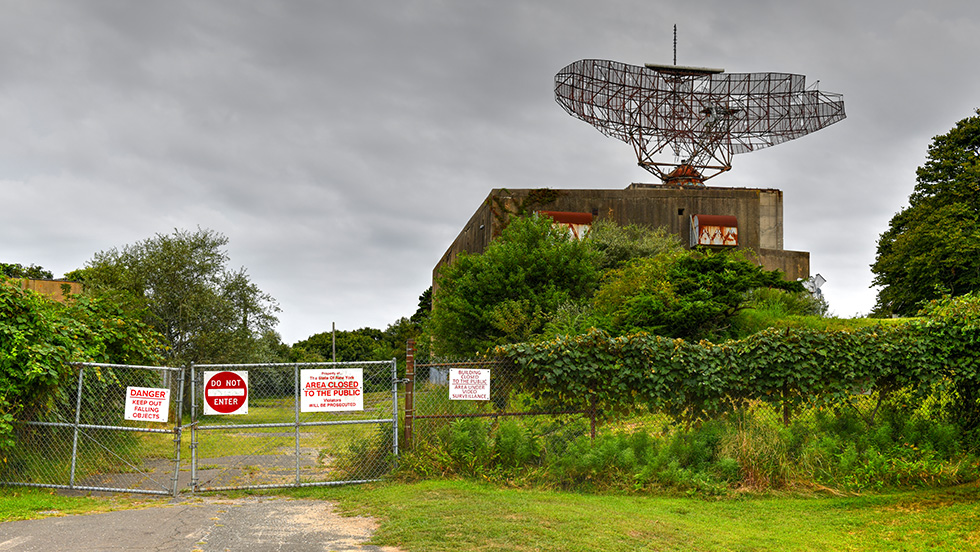
Before Hawkins, Indiana, there was Montauk, New York. True story: The Netflix series Stranger Things was originally titled Montauk by the Duffer Brothers, creators of the hit series, and it was set on Long Island rather than Indiana. Its real-life inspiration is a former military installation—Camp Hero, now a state park—with a defunct radar dish that still looms over the cliffs of Long Island’s eastern tip, and whose history is mired in Cold War secrets, conspiracies and urban legends.

Michael LaCombe, PhD, Associate Professor of History
In this Q&A, we sit down with Michael Lacombe, PhD, associate professor in the Adelphi University Department of History—and Stranger Things superfan—to leaf through the series’ folklore. From the base’s original purpose to the “Satanic Panic” of the 1980s, Dr. Lacombe offers his thoughts on how the era’s paranoia mixed with the eastward explosion of suburban Long Island created an ideal breeding ground for Stranger Things.
He also offers a historian’s-eye critique of the show’s evolution, the “mindset” of the 1980s and why the series finale might have played it a little too safe—spoiler alert!
Camp Hero has been called the “Hawkins Lab” of the East End. What can you tell us about the original purpose of this base during WWII and the Cold War and why it became such a fixation of conspiracy theories?
I have no idea what the base was built for and what it may have been used for while it was active. I think that even today and especially during the Cold War, secrecy is kind of a reflex reaction for most of the military: They didn’t and don’t really need a good reason to keep things classified, beyond the fact that it makes it harder for us taxpayers to know where our money is going.
Some of the Cold War espionage stories I do know about seem either banal or just bizarre, like planting a booby-trapped seashell for Fidel Castro to find while snorkeling. If someone smuggled news of that plan out of a place like Camp Hero, or got drunk at a local bar on the East End and talked too much, no one would believe that was the real plan. A booby-trapped seashell? There would be all sorts of speculation about what the “seashell” is, and the military would encourage the weird stuff to make it even harder to know what was really going on.
Area 51 is the best example: I’ve read recent articles that claim the military has fostered and even spread weird stories about aliens there to cover up the more unsavory aspects of what they do everywhere. And they may also think it’s fun, trolling the civilians.
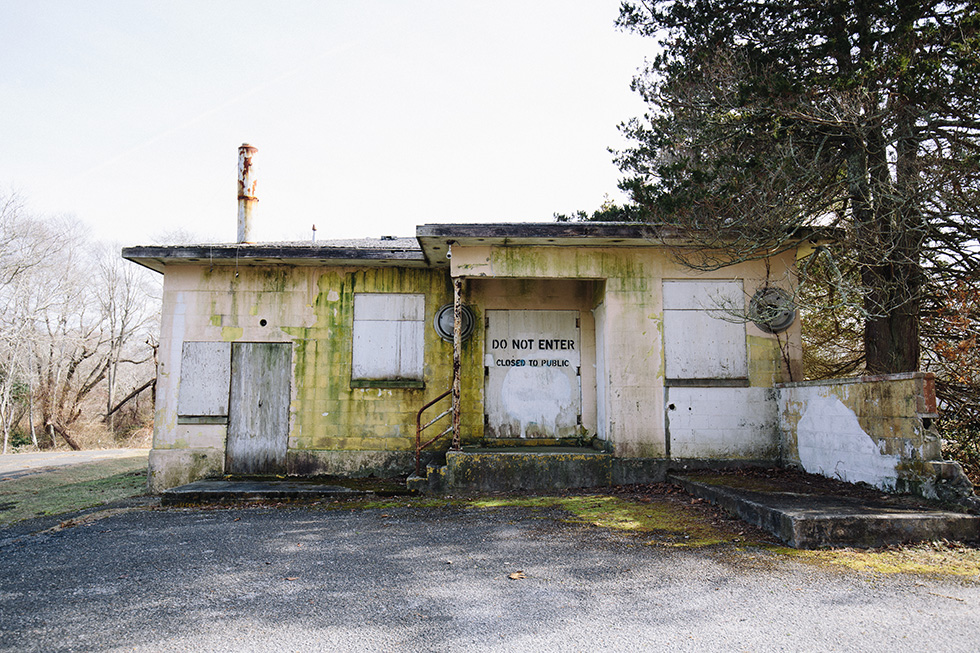
A structure that is one of the many support buildings located at Camp Hero State Park in Montauk, NY, the real-life inspiration for “Hawkins Lab” featured in Netflix’s Stranger Things.
Do you have any thoughts on how Camp Hero influenced the mythology featured in the series?
I’m sure the base was built when there was nothing much out there and Long Island grew to meet it, so it was surrounded by ordinary people doing ordinary things by the time of the Cold War. That was also (of course) the time of the automobile and the highway and the explosion of population on Long Island, so all of a sudden suburban neighborhoods found themselves next to “secret” bases. I think this is an important part of how this mythology grew, as the American population exploded and expanded in the years after World War II.
You could say the same thing about wolves or mountain lions: They’ve always been there, of course, but now people have moved into their territory and surrounded them and they’re a thing, a problem—military bases haven’t been there that long, but I think it’s likely that in the 70s and 80s people just started to notice them.
Hawkins’s status as a kind of Everytown USA, with a mall and a Blockbuster, is very important to the show, and I imagine that 75 years ago Montauk could have thought of itself in the same way (like Amity Island was in the Jaws movies). It’s hard to imagine anyone envisioning the East End as Everytown USA today.
Are there any elements of the Camp Hero project that still remain in Montauk?
I’ve never been out there, but I understand there are some beautiful, rusting relics still standing: a radar tower and gun emplacements (there are lots of these, it turns out—I’m familiar with a series of bunkers and gun batteries in Casco Bay, Maine). I think responsibility is now New York state’s and not the Army or the federal government, and that some areas are closed off because they’re dangerous and/or contaminated. And (as we know from the Hudson River) it takes a lot of time and money to remedy some kinds of environmental contamination. But all this feeds back into the reason why we’re interested in such places and why being forbidden to go there makes us even more interested and curious—and dubious—about the boring official explanations (you are likely to be seriously injured and the Army doesn’t want to get sued).
Think about this comparison: The Army gave Governor’s Island to New York City and the state, but there are no stories about that: It’s a beautiful place, largely intact, that’s now a park with great old brick buildings and astonishing views. But the barbed wire, rusting tower, gloomy bunkers and “Danger–Keep Out” signs just lend to Camp Hero’s eerie 80s aura. And there are lots and lots of photo-essays of dead malls with weeds growing in the food court—it’s the same vibe of mysterious and evocative places.
And anyway, we’re still talking about it!
Eleven’s story is said to be grounded in the CIA project MKUltra. The Hellfire Club is a nod to the “Satanic Panic” of the 80s. And so much of the series is colored by fears from the Cold War era. Can you delve a little deeper into the American history that influenced the show?
The Hellfire Club was also a big shout-out to the original Dungeons & Dragons (D&D) players from that era. A lot of cool people today pretend they were “really into” D&D in the 80s, but they weren’t—it was a game for outcasts and recluses and misfits like Eddie and Dusty Buns and the gang. D&D changes the equation of the popular fear of satanic influence, too—there was a lot of fear in those days just as there is today, about mysterious forces preying on American youth. It wasn’t communism anymore (even the Reagan administration couldn’t make a credible case that American teenagers in the 80s were closet commies). But the broader conspiracy theories that the show is based on (secret bases, secret experiments, the military/scientific/paranormal) acted at the time against all sorts of things. The day care panic destroyed lives, and the D&D panic just made it impossible for a kid I played Little League with to come over and play D&D with us. But I think the show didn’t just plant 80s cultural references like Easter eggs: It had a very 80s mindset and sensibility.
So I thought one of the most interesting things about the show was not that it was “about” anti-communist fears of sinister satanic forces infiltrating small-town, authentic American heartland lives. That was all true in the show, right? The Soviets really were training a strike force of interdimensional creatures and all that. It was more the way it inhabited that 80s world of paranoia so fully, the same world that gave us all those classic horror franchises. Subterranean tunnel networks—what could be a more obvious symbol of this? A parallel dimension—all of that.
So the varsity hoops team beating up the D&D club was part of the way the show inhabited the 80s sensibility, but so was the casual way that our heroes, including Sheriff Hopper (a Vietnam vet—another essential element of the 80s anti-government conspiracy mix) shot American soldiers as they invaded the base in the final season. That was right out of Rambo, and I found it frankly jarring—there was another scene where an Army sniper in a helicopter was gunning down scientists fleeing a secret desert lab, laughing as he shot them. The portrayal of soldiers in these ways was really not something we’re used to seeing much these days.
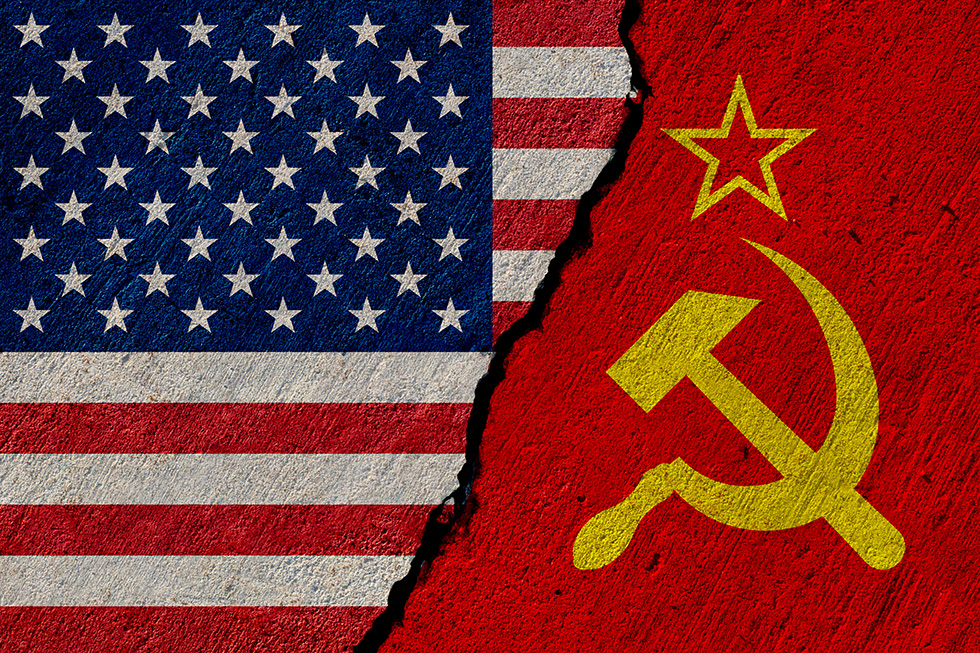
Stranger Things was rooted in the very real tensions of the Cold War.
Most importantly, what did you think of the ending?
Not enough death. I think the show took on a cultural resonance way bigger than its story and characters, and (let’s face it) the “tension” between Nancy and Jonathan or the bromance between Dustin “Dusty Buns” and Steve “The Hair” Harrington was never going to sustain the show. So they added character after character, and only Eddie and Bob ended up dying. I thought both of those characters’ deaths were important and gripping, and I thought we’d see a few more as they wrapped things up. But I think it just became impossible to kill off Mike, or Max, or Robin, or Hopper, etc., etc.
So as the final season wrapped up, we were left with a lot of long conversations to tie up plotlines that took too much time and were kind of implausible. Joyce vanished, and she was not only a great character but also Winona Ryder, which is a very important point to a person my age. But the biggest problem was time: There wasn’t enough time for the final boss fight, so it was a letdown—Nancy got to blast things, okay, but it was too easy. And no one died!?! Who’d have thought Hawkins v. Vecna would be a shutout?
These multi-season streaming series are a strange and new phenomenon, almost a new form of storytelling. The show writers try to get renewed, so they open up the conflict the way Stranger Things did in the first couple seasons without resolving it (so they *have* to make a new season and get paid). But this kind of narrative lends itself to just this sort of problem. My daughters would have been very sad to see Max or Robin die in the finale, so why do it? It would have soured the show for them, and the finale served the purpose of the show well enough. Not every series can end perfectly the way Breaking Bad did.