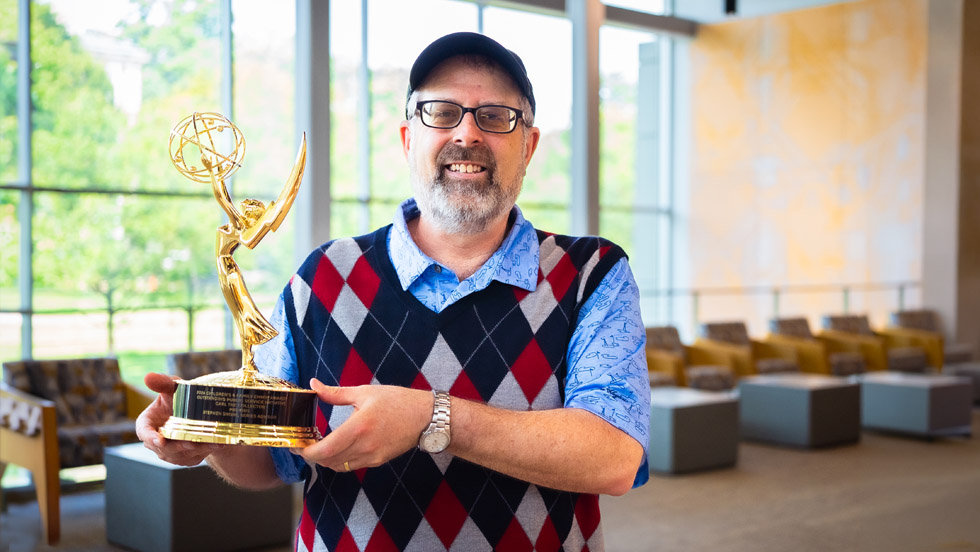
A globally renowned expert in the field of autism has now earned an Emmy Award for his work on a PBS children's show. Dr. Shore, who is on the spectrum, advised the show's creators on how to accurately portray neurodivergence.
As a child, professionals recommended that young Stephen Shore be institutionalized. Seeing his many abilities, his parents refused—an origin story he now weaves into his public talks and teaching.
Today, Stephen Shore, EdD, is a clinical associate professor in the Ruth S. Ammon College of Education and Health Sciences and has added a new honor to a long and successful career in neurodivergence advocacy: a 2026 Emmy Award.
The longtime educator, author and international speaker received the award for his work as technical advisor on the PBS KIDS breakout animated series, Carl the Collector. The show, about a raccoon on the autism spectrum and his friends, won the 2026 award for Outstanding Public Service Initiative at the 4th Annual Children’s & Family Emmy Awards in New York.
The show has drawn accolades for presenting autism as a different—not disordered—way of being.
Adelphi is already a national leader in educating students on the spectrum. Bridges to Adelphi, a program for neurodivergent students, won the Grand Gold Medal for Equity, Inclusion, Social Justice and Related from the National Association of Student Affairs Administrators in Higher Education (NASPA) in 2022 and 2023.
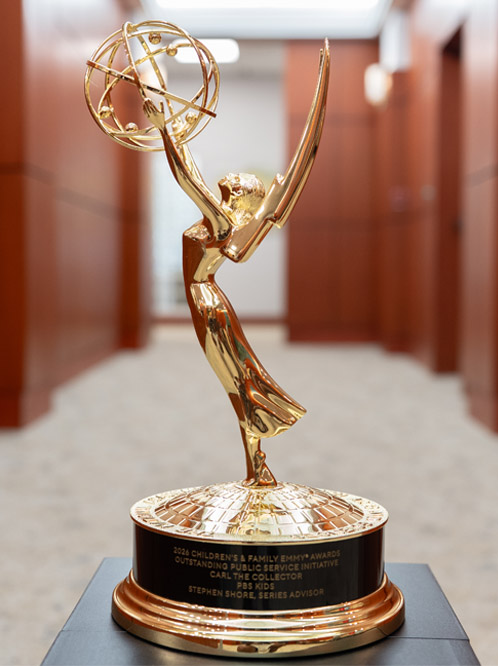
The inscription on Dr. Shore’s Emmy Award reads “2026 Children’s and Family Emmy Awards/Outstanding Public Service Initiative/Carl the Collector/PBS Kids/Stephen Shore, Series Advisor”
An Emmy for Getting Autism Right
Dr. Shore’s role as technical adviser meant he reviewed every story, script and stage of animation to ensure that Carl the Collector portrays autism accurately while showcasing the strengths of these individuals in a way that resonates with children, parents and educators.
“My job was to comment on how Carl and the other characters might react or communicate in any situation,” he said.
The result is a show that critics have praised for its commitment to authentic representation of neurodivergence because the series is crafted by a team that includes neurodiverse writers, animators and advisers.
Dr. Shore was a key part of the team because he brings not only academic expertise but also lived experience to Carl the Collector: He is on the spectrum himself. Able to take apart intricate watches and reassemble them at a young age, his parents recognized unique talents amid his challenges.
That personal history shapes his insistence that autism be framed as a “different rather than disordered way of being,” and it propels his career as a nationally known expert and author on neurodivergence; he has written extensively, presented in 59 countries, and uses both the classroom and the screen to model what authentic representation and true inclusion can look like.
An Emmy to Call His Own
Dr. Shore originally assumed the Emmy recognition belonged purely to the series. “My thought was that the Emmy was awarded to the show, and we all got to share in the Emmy, and that was great,” he recalled. Then, in May, a large box arrived at his home.
Inside was an Emmy statue with his own name on it, honoring his individual contribution.
“It made me very proud,” he said. “I’m so pleased that others have found my experiences and what I have to say about them to be worthy of inclusion and on such a massive and grand scale.”
A Warmhearted World for Kids—and Adults
Carl the Collector follows Carl, a logical young raccoon on the autism spectrum who loves amassing meticulous collections of everything from rare leaves to unique bottle caps. Carl uses his extraordinary attention to detail to help his neurodivergent and neurotypical friends solve everyday dilemmas. Alongside his best friend, Sheldon the beaver, and Lotta, a talented neurodivergent and artistic fox, Carl learns to navigate big emotions and unexpected changes in plans within a supportive community that celebrates everyone’s unique traits.
Beneath the visual charm is a clear purpose: acceptance. “Everybody helps each other out,” Dr. Shore said. “Sometimes there are misunderstandings, but they all work out in those 11 minutes and four seconds and seven hundredths of a second.”
From “Institutionalization” to Institutions of Honor
The Emmy resonates deeply against the backdrop of Dr. Shore’s childhood. As he notes in his autobiographical presentations, professionals wanted to admit him to an institution. His parents declined.
“Perhaps, in a way, those diagnosing professionals were correct, and that I needed to be in an institution,” he notes wryly. “An institution of higher education.”
Now, he adds with a smile, he’s also part of the “institution called the Emmy Awards.”
Bringing Carl Into the Classroom—and Beyond
Dr. Shore’s involvement with Carl the Collector is tightly woven into his education classes at Adelphi and his advocacy work. During production, final episodes were embargoed until broadcast, but once released, he said he “went wild” incorporating them into his Special Education (Teaching Students With Disabilities) classes and presentations. For his students, Carl the Collector is a case study in authentic representation. For conference audiences of educators and clinicians, it’s a model of how media can portray autism with accuracy, warmth and respect.
Production on a second season of Carl is currently up in the air due to funding shortages at PBS, Dr. Shore said, although other organizations have expressed interest in sponsoring the show. “When we get the green light … we open those toolboxes, fire up all the engines and get going again.”
Until then, the Emmy on the shelf is a tangible reminder of how far he—and the broader understanding of autism—have come.