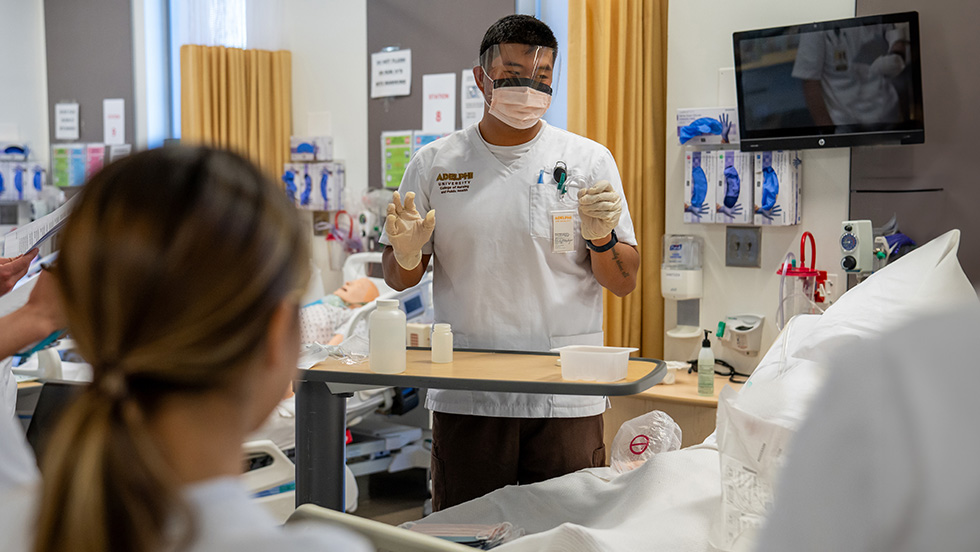
A Healthcare Theatre course enlisted theatre majors as stand-ins for patients in an accredited simulation lab that helps nursing students build LGBTQ+ cultural sensitivity.
In the healthcare system, cultural competence can mean the difference between life and death. Research has shown that LGBTQ+ patients will not seek care if they feel misunderstood by providers. Yet the curricula of many nursing schools do not incorporate content on gender identity and sexual orientation, leaving nursing graduates unprepared to meet the needs of their LGBTQ+ patients.
At Adelphi, a simulation-based learning program is closing that knowledge gap. The program is the brainchild of two faculty members in Adelphi’s College of Nursing and Public Health (CNPH): Virginia Oates, DNP, clinical assistant professor, and Daniel McWeeney ’07, DNP, clinical associate professor. “Some people think LGBTQ+ education belongs at the graduate level for nurses, but we believe otherwise,” Dr. Oates said. Dr. McWeeney, who works as a nurse practitioner in emergency medicine, agrees. “Our new graduates will need to be prepared to care for diverse populations. They must also feel ready to respond to unpredictable situations that they will likely see on a daily basis in their practice.”
Preparing students for real-world nursing practice—in particular, the care of LGBTQ+ patients—means exposing them to those unpredictable situations up close. Drs. Oates and McWeeney partnered with Adelphi’s Department of Theatre to create a special interdisciplinary educational intervention. The result, a semester-long Healthcare Theatre course, trained theatre students to take on the role of standardized patients (SPs), enabling nursing undergraduates to rehearse scenarios with living, breathing people. The team also enlisted a gender content expert to produce a culturally sensitive, medically accurate script. Findings from their collaboration were published as “Improving baccalaureate nursing students’ cultural sensitivity with LGBTQIA+ patients using theater students as standardized patients” (Clinical Simulation in Nursing, October 2025).
When the semester began, Drs. Oates and McWeeney primed their nursing students on best practices in SP role-play simulation. Then the students headed into the lab to take sexual health histories of their SPs, played by theatre majors. Though the scenarios were fully scripted, SPs rated each interaction on the basis of clinical skills, communication and empathy.
The simulations were conducted in Adelphi’s Clinical Education and Simulation Lab (CESiL), which recently earned accreditation from the Society for Simulation in Healthcare—making Adelphi the only school on Long Island to hold such a designation. CESiL contains seven clinical exam rooms, a delivery suite, a pediatric space and a home-care setting as part of its fully immersive simulation environment. It’s also equipped with several high-fidelity manikins, a cutting-edge teaching tool that can replicate human physiology and respond organically to medical treatment. From behind a glass window, CESiL lab techs control the manikins’ speech, heart rhythms, breathing sounds and eye movements. This allows students to encounter medical challenges in real time. “We can, for instance, imitate a stroke incident where the manikin’s face will droop,” Dr. Oates said. “The manikin can deteriorate. It can even die.”
A negative outcome in CESiL is often a student’s best learning experience. Simulation practice concludes with a staff-led debrief, which Dr. Oates said is “the most important part” of experiential activity. “Students can talk about what they could have done better, what they were uncomfortable with, how they felt. It lets them unravel what went wrong in a safe space.”
During the LGBTQ+ simulation project, debriefs centered on students’ knowledge—what they hadn’t known before, what they’d learned—as well as mistakes they’d made in front of the patient. “If a student accidentally misgendered the SP, it doesn’t hurt anyone. It’s a learning space, and we talk about it,” Dr. Oates said. “Then the student is aware of what they need to do better in a real patient interaction.”
According to Dr. Oates, student response to the pilot program was incredibly positive. Students saw an improvement in their ability to meet patient needs and communicate effectively about LGBTQ+ health topics, especially sexual and reproductive health. They also practiced working with evidence-based tools, like mental health and substance use screenings that are employed every day in hospitals and clinics.
CNPH has accelerated its investment in simulation-based learning in recent years, responding to a statewide shortage of clinically prepared nurses. Dr. McWeeney calls simulations “a critical part of our curriculum” and a “powerful tool for students.” “By engaging with trained SPs who portray the highest fidelity,” he said, “our students are exposed to emotionally complex situations—such as asking very personal questions while taking a sexual history—and can practice communication strategies in a safe, supportive environment.”
Dr. Oates added, “Simulations are a bridge between theory and the real world. Now students won’t get thrown off the deep end after they’ve learned something in class. The lab gives them a place to practice meeting today’s healthcare challenges.”
Frequently Asked Questions
Research has shown that LGBTQ+ patients will not seek care if they feel misunderstood by providers. Yet many nursing school curricula do not include content on gender identity and sexual orientation, leaving graduates unprepared to meet these patients’ needs.
Virginia Oates, DNP, and Daniel McWeeney ‘07, DNP, of Adelphi’s College of Nursing and Public Health created a simulation-based program in collaboration with Adelphi’s Department of Theatre. In a semester-long Healthcare Theatre course, nursing undergraduates took sexual health histories from standardized patients played by theatre majors, using a script produced with a gender content expert.
A standardized patient is a trained actor who plays a patient so nursing students can rehearse scenarios with a real person. In Adelphi’s program, theatre students served as SPs and rated each interaction on clinical skills, communication and empathy.
CESiL is Adelphi’s fully immersive simulation environment. It recently earned accreditation from the Society for Simulation in Healthcare, making Adelphi the only school on Long Island with that designation. The lab includes seven clinical exam rooms, a delivery suite, a pediatric space, a home-care setting and high-fidelity manikins that replicate human physiology and respond to treatment.