Anthropology Field Research
At Adelphi University, anthropology research empowers students to work closely with faculty on projects and gain real experiences in the field.
From your first year, you can engage in hands-on field or lab work in areas such as archaeology, ethnography, participant observation, community development, or environmental anthropology. Students learn to apply anthropological methods to real-world questions about societies past and present.
Consider donating to the Archaeology Lab to directly enhance student research.
To receive credit for research:
- Interview faculty during your first semester
- Join a research project or field program early in your studies
- Select a faculty mentor and research focus by your sophomore year
- Register for research credits with faculty approval
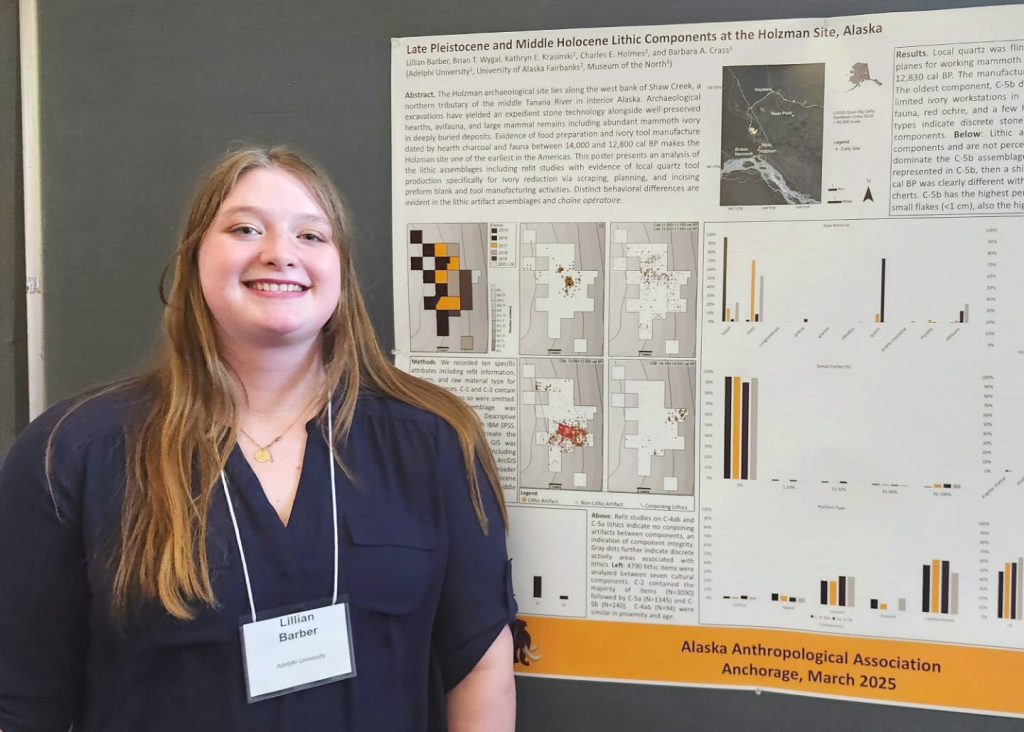
Lillian Barber ’25 presenting her research poster “Late Pleistocene and Middle Holocene Lithic Components at the Holzman Site, Alaska” at the 2025 Alaska Anthropological Association Annual Meeting in Anchorage, Alaska.
Students present their work at the Adelphi Scholarship and Creative Works Conference and may also share their research at regional and national anthropology conferences.
Through the SPARK Center (Scholars Pursuing Arts, Research and Knowledge), students can receive funding, mentorship, and support for independent research and conference presentations.
Field Research Opportunities
Anthropology faculty at Adelphi continue to conduct research around the world, with projects in North and South America, India, and Africa. Faculty experiences inform coursework and provide students with opportunities to explore global perspectives, cultural diversity, and human interactions with their environments.
Faculty Research and Areas of Focus
Kathryn Krasinski, PhD specializes in Indigenous archaeology, food systems, and ecological anthropology. Her research includes community-based projects in Alaska, Africa, and the Falkland Islands, examining subsistence practices, climate adaptation, and the relationship between culture and environment.
Brian Wygal, PhD researches environmental archaeology and human adaptation in northern ecosystems. With more than two decades of archaeological fieldwork in Alaska, his work explores human ecology, climate change, Indigenous histories, and archaeological field methods.
Hanna Kim, PhD studies transnational religious communities, globalization, and social change. Her long-term ethnographic research focuses on the BAPS Swaminarayan Hindu community, with fieldwork conducted across India and global diaspora communities. Her work examines how religious identity, entrepreneurship, and cultural networks shape modern global societies.