Mathematics and Computer Science Research
At Adelphi University, mathematics and computer science research gives students the chance to work closely with faculty on innovative projects.
From your first year, you can explore cutting-edge areas like AI, cybersecurity, software engineering, applied mathematics, and computational modeling. Students apply classroom learning to real-world problems while gaining technical skills and professional experience.
To receive credit for research:
- Interview faculty during your first semester
- Select a permanent research group by the end of your sophomore year
- Register for research credits with faculty approval
Students present their work at the Adelphi Scholarship and Creative Works Conference and may also participate in regional and national conferences.
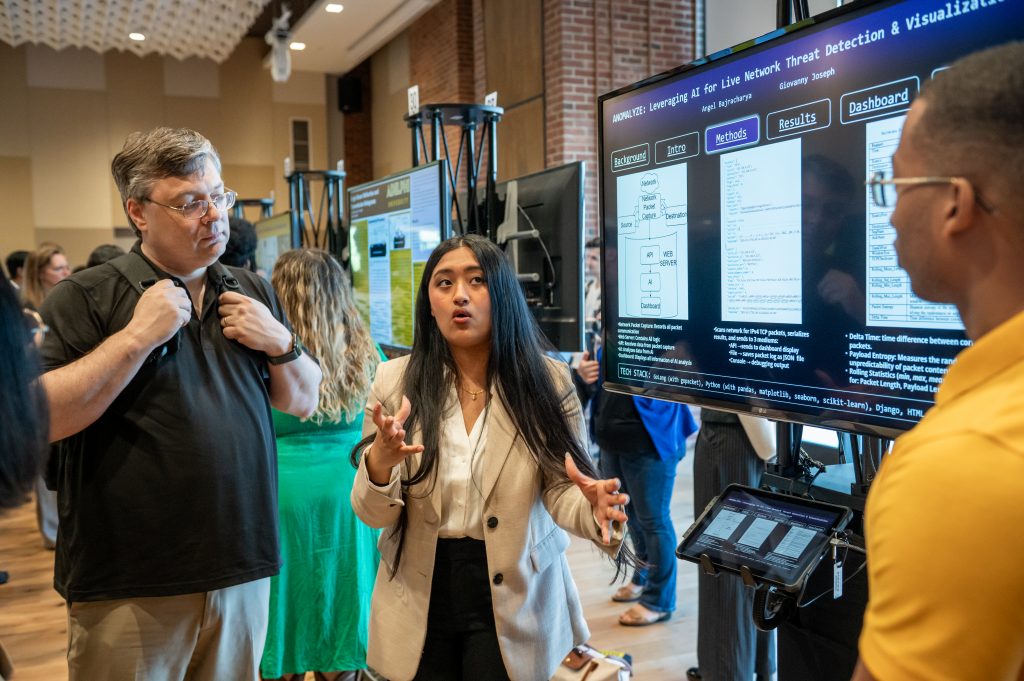
Presenters share their research at Adelphi University’s Annual Research Conference, highlighting innovative ideas and discoveries.
Undergraduate Student Research
Undergraduate students can engage in guided research alongside faculty mentors, gaining hands-on experience in projects that advance their technical and analytical skills.
Whether completing a capstone project, pursuing honors, or gaining research experience, students receive guidance through:
- SPARK Center: Support with project planning, mentorship connections, and presentation preparation for undergraduate projects
- Innovation Center: Opportunities for interdisciplinary, project-based research and exploration
Graduate Student Research
Graduate students in our master’s programs can participate in research as part of a thesis or voluntarily. Faculty supervise projects in areas such as software engineering, AI, cybersecurity, and applied mathematics.
Faculty Research and Areas of Focus
Xiaoxing Liu, PhD explores human-computer interaction and computational methods. Students study interfaces, algorithms, and systems that improve user experience through mathematical and computational models.
Robert Siegfried, PhD investigates how disabled and neurodiverse users interact with computer systems. Students contribute to projects exploring accessibility solutions, inclusive design, and usability testing to make technology more equitable.
Lee Stemkoski, PhD explores the state-of-the-art in augmented and virtual reality. Students in his research group work on AR/VR design, simulations, and experiments that bridge computer science theory with real-world applications. He also serves as the director of Adelphi’s Innovation Center, fostering collaboration and innovation across disciplines.
Kees Leune, PhD focuses on defensive cybersecurity and enterprise threat analysis, with particular interest in access control theory, information security management, and modeling security systems. Students in his group explore threat analysis and model defensive strategies that help organizations anticipate, visualize, and mitigate modern cyber risks.
Sung Kim, JD specializes in cybersecurity, data privacy, and the intersection of technology with societal and legal issues. He brings a multidisciplinary approach that helps students connect secure system design with broader ethical, policy, and usability concerns. Student projects under his guidance range from applied cryptography to senior capstone work that tackles real technology challenges.
Tuval Foguel, PhD, researches finite group theory and algebraic structures. His work explores the properties of subgroups and introduces new concepts in abstract algebra. Students collaborate on theoretical mathematics projects and learn to connect abstract concepts with problem-solving strategies.
Robert Siegfried, PhD, brings an interdisciplinary approach to mathematics, integrating materials science and computing. His students work on computational modeling and applied mathematics projects that address real-world engineering and scientific challenges.
Anil Venkatesh, PhD focuses on applied mathematics and computational methods, with research spanning music information retrieval, stochastic modeling, and data-driven analytics. Students work on projects applying mathematical and computational techniques to real-world problems, including marketing analytics and industry-based solutions.
David Chays, PhD, researches effective teaching and learning strategies in mathematics and computer science. His work focuses on developing methods that improve student engagement and outcomes in STEM classrooms.