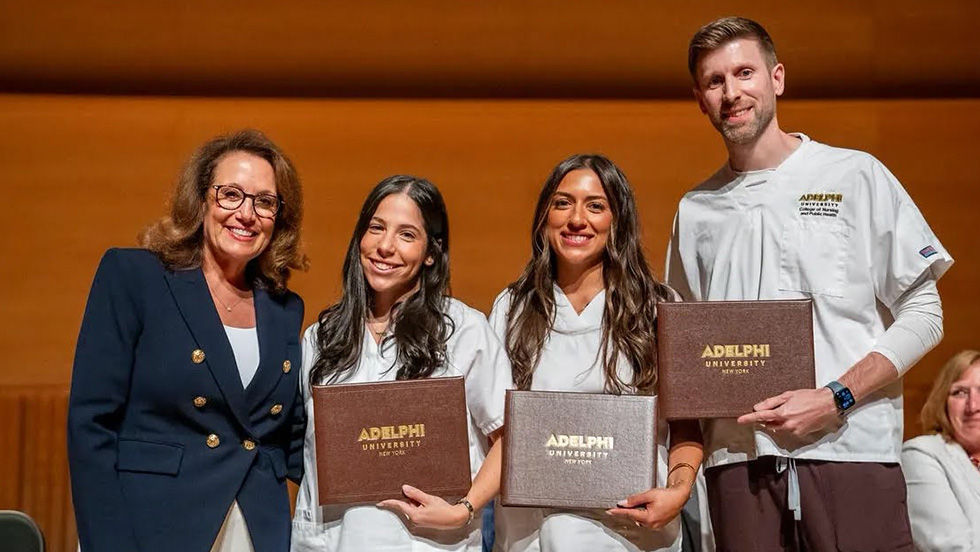
The Big Brother/Big Sister Program supports aspiring nurses in the accelerated BSN program by pairing students with peer mentors.
For the future nurses in Adelphi University’s Accelerated Bachelor of Science in Nursing Program, school is a full-time job. The fast-track program features a rigorous curriculum that doesn’t let up for the better part of 15 months, which can be a test for any student. Peer mentoring through the College’s Big Brother/Big Sister program brings calming support to help students be successful.
Irene Auteri ’79, PhD ’22, assistant professor in the College of Nursing and Public Health and director of the Accelerated BSN Program, started the mentorship program two years ago after noticing many students asking for advice on how to study. “I thought it would be more impactful if I had upperclassmen talk to them,” Dr. Auteri said. “Sometimes, students don’t want to talk to a teacher. They’d rather talk to another student.”
Shaped by her own mentorship experience in nursing school, Dr. Auteri considers peer mentoring key to developing well-rounded nurses—and central to the field of nursing itself. “Nursing is a team sport,” she said. “We all want each other to be successful, so why not help each other be successful?”
Finding a Big Sister
Eunyoung Kim, a first-generation immigrant from South Korea, worked as a stay-at-home mom, and then at a Korean bank in Flushing, New York, before she decided to take on the challenge of nursing school. “Nursing appealed to me because it offered different work settings and scheduling options, along with the prospect of a stable, licensed profession,” Kim said.
But moving from a Korean company with colleagues and clients who spoke her language to a rigorous nursing program taught entirely in English proved challenging. “Because English is not my first language, the workload felt two or three times more demanding,” she said. “Almost every day, I worried about whether I could successfully finish the semester.”
She realized she needed help. She remembered learning about the Big Brother/Big Sister Mentorship Program during Orientation and decided to reach out. “I wanted to hear from someone who had already been through the nursing program,” Kim said.
Dr. Auteri paired Kim with Melissa Vo ’26, who quickly put her at ease. They kept their communication informal rather than on a fixed schedule, with Kim reaching out whenever she had questions.
She recalled one particularly stressful week. With four exams coming up and her husband away for two weeks, she was exhausted and overwhelmed from caring for her daughter while studying. She shared her situation with Vo, telling her she didn’t have enough time to cover all the material. “Melissa helped me prioritize based on my circumstances and suggested using AI tools to create practice questions,” Kim said. “Her advice gave me practical ways to make the most of my limited time.”
With hard work and Vo’s help, Kim passed her classes and feels more prepared for the remainder of the program. “The program is still challenging, but I’m less anxious and more in tune with myself,” she said.
Taking the Fear Out of Med Calc
Aspiring nurses can also join group mentoring sessions, such as reviews for the medication calculation (med calc) exam, which tests whether students can accurately calculate medication doses.
James Bunn Jr. ’26, who switched to nursing from a career in sales and marketing, attended one of these sessions during his first semester. “The math is not that hard, but they test you in a stressful environment to see if you can do this accurately and without making any mistakes,” Bunn said.
The stakes are high: Juniors must score at least 90 percent and seniors 100 percent, with limited chances to retake the exam. Students who don’t pass can lose their spot in the program. Understandably, that makes many students anxious.
For Bunn, the mentoring session helped change his outlook. “When you had a student sit up there and walk you through it and say, ‘Here’s how I learned it, and when you stop, take a breath and look at it, it’s not as complicated as it appears,’ that really shifted my thinking,” he said.
So when Bunn had the chance to mentor others, he jumped at it. This summer, he and classmate Emily Maistelman ’26 led a session for about 30 incoming students. They started by reassuring them that while the exam should be taken seriously, it wasn’t something to lose sleep over. “Let’s take the anxiety part out first, because it’s a lot harder to learn something when you’re anxious,” Bunn said. Then they walked students through the process and shared tips for reading exam questions.
The peer coaching paid off: Every student passed the exam. Bunn noted that he and Maistelman weren’t telling students anything their professors hadn’t already said. What made the difference was who was saying it.
“When it’s coming from peers who are down in the trenches with you, know what it means and have gone through it, it just hits a little different,” he said.
A Fast Track Built on Support
The Big Brother/Big Sister Program fits the larger idea behind Adelphi’s Accelerated BS in Nursing: Change careers quickly without going it alone. The program is built for students who already hold a bachelor’s degree in another field, allowing them to earn a BSN in just 15 months. Students move through it with a cohort of classmates and are guided by dedicated faculty, getting hands-on clinical experience at dedicated education units across Northwell Health, Memorial Sloan Kettering, NYU Winthrop and Catholic Health Services.
Students also train in Adelphi’s Clinical Education and Simulation Lab (CESiL), a 22-bed lab that is the only one on Long Island accredited by the Society for Simulation in Healthcare. The results show: As of 2025, the program’s graduates have a 100 percent first-time pass rate on the NCLEX-RN, and allnurses named it one of the Best New York ABSN Programs for 2026. The program admits students in January, May and August at the University’s Garden City campus and its Manhattan Center, with rolling admissions. That gives career changers more chances than ever to join a community where the students who came before them are ready to help.