
With the help of a therapy dog, Echo, for inspiration, clinical educator and adjunct professor Emily Tullo shares her guidance for students navigating college for the first time.
As an executive function coach in Adelphi University’s Learning Resource Program, with my colleague Erin Truesdell, a senior clinical educator and adjunct professor, I have a unique approach to helping first-year students navigate their initial steps on campus. Together, we guide them to find inspiration with the help of a canine professor named Echo.
For our newest students, I think walking onto campus for the first time causes the same uncertainty that a dog feels when it steps into an unfamiliar dog park. The environment is overwhelming, the social dynamics are entirely new, and everyone is trying to figure out exactly where they fit in. Finding your footing in this transition requires adaptability, resilience and, above all, a willingness to connect.
When you break it down, the skills required to understand a canine companion are identical to the executive functioning skills first-year students need to thrive on a college campus:
- Reading the Room (Nonverbal Cues): Dogs communicate almost entirely through posture, energy and subtle micro-expressions. Similarly, walking into a lecture hall, a bustling dorm lounge or a professor’s office requires new students to develop a keen sense of situational awareness and social attunement.
- Building Trust Over Time: A dog does not offer its trust overnight; earning it requires consistency, patience and clear boundaries. Navigating early college friendships and professional relationships with faculty follows this exact same trajectory.
- Co-Regulation and Stress Management: The human-canine bond is famous for its biological benefits—lowering cortisol levels while boosting oxytocin. We leverage this behavioral concept to teach students how to manage the intense anxiety of their first semester, using the grounding nature of the human-animal bond as a framework for active self-care.
Launching a First-Year Seminar on the Human-Canine Connection
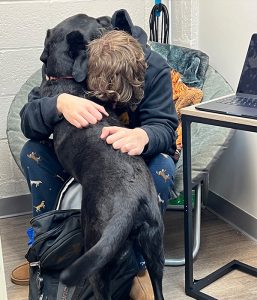
The human-canine bond has real biological benefits; it lowers cortisol levels and boosts oxytocin.
Inspired by the many lessons Echo has taught us, we took our approach to a new academic level and launched a first-year seminar dedicated to the human-canine connection.
This course is one of 46 engaging first-year seminar options at Adelphi—ranging from Becoming Human and The Psychology of Happiness to The Politics of Immigration. These seminars offer a vital space for students to explore new ideas and engage in dialogue with professors and peers, and most students must complete one to graduate. The first-year seminar is part of Adelphi’s general education requirements, or PATH (Preparation, Awareness, Transformation, Hands-On Learning).
Bringing this particular course to life is Echo, a gentle and beautiful black Labrador retriever. Echo’s presence completely transforms the traditionally rigid college classroom into a warm, low-stress sanctuary. For an anxious first-year student, walking into a room and being greeted by a calm, accepting dog instantly lowers defenses. The dog acts as a living, breathing teaching assistant, offering students a real-time lesson in emotional co-regulation and providing a comforting touch of home just when the student needs it most.
Executive Functioning on Both Ends of the Leash
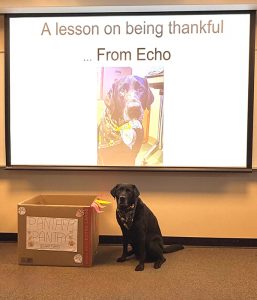
Echo is a welcome sight around campus; here she is at a fund-raising event for the Panther Pantry.
In our course, we teach students that training or understanding a dog demands working memory, emotional control, cognitive flexibility and sustained attention—the very definition of executive functioning in humans and canines alike.
The co-evolution of humans and dogs is a master class in behavioral adaptation. For thousands of years, two completely different species have learned to read each other’s body language, build trust from scratch and form mutually beneficial partnerships. By analyzing how dogs and humans successfully formed one of history’s greatest partnerships, and watching those dynamics play out with Echo in the classroom, students learn how to take active control of their own schedules, emotional health and social lives.
For New Students, a Lesson From Echo
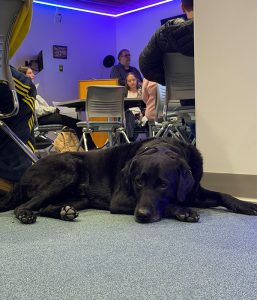
According to executive function coach Tullo, “Echo’s presence completely transforms the traditionally rigid college classroom into a warm, low-stress sanctuary.”
Ultimately, this first-year seminar is a reminder to our newest students that the journey of higher education is not a path they have to walk alone. Success in college—much like building a bond with a trusted companion—does not happen overnight. It is built in the small, quiet moments of patience, open communication and the courage to reach out to someone new.
So as you navigate your own way through these unfamiliar hallways, remember the lesson Echo teaches us every single day: Hold your head high, stay calm, earn the trust of your new friends and never underestimate the power of a strong connection.