Sociology and Criminal Justice Research
At Adelphi University, sociology and criminal justice research engages students in examining social systems, inequality and justice
From your first year, you can explore research in areas such as social inequality, criminology, justice systems, race and ethnicity, gender, public policy and community-based research. Students develop strong analytical, research and critical thinking skills while applying sociological perspectives to real-world issues.
To receive credit for research:
- Meet with faculty early to discuss research interests
- Identify a focus area aligned with sociology or criminal justice
- Develop a research question with faculty mentorship
- Register for independent study or research credits with approval
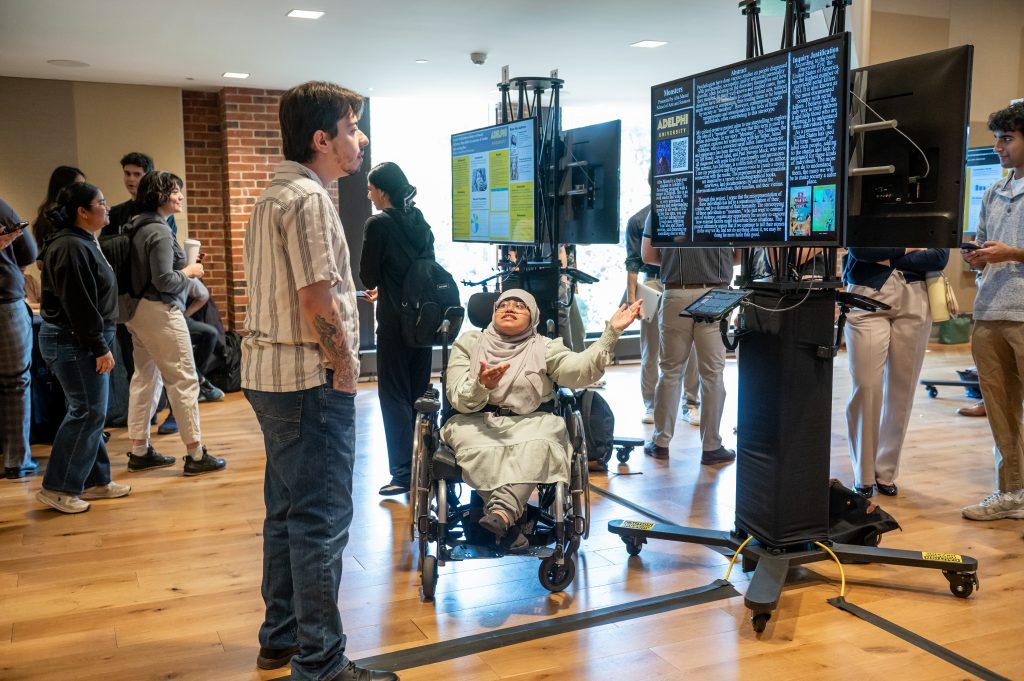
Afra Masud, a first‑year student majoring in sociology and minoring in English, showcases her work at the annual Scholarship and Creative Works Conference.
Students present their work at the Adelphi Scholarship and Creative Works Conference and may also participate in internships, community partnerships and regional or national conferences.
Through the SPARK Center (Scholars Pursuing Arts, Research and Knowledge), students can access funding, mentorship and support for independent research and conference presentations.
Faculty Research and Areas of Focus
Jessie Klein, PhD is a scholar of gender, violence, and youth culture. Her research examines sexual violence, bullying, and school climate, with a focus on how social institutions shape experiences of safety, inequality, and identity among young people. Her work bridges sociology and education to inform prevention, policy and institutional change.
Jacqueline Olvera, PhD is a scholar of urban and migration processes. As a mixed-methods researcher, her work examines issues such as neighborhood change, low-income communities, and immigration. Her most recent project is a qualitative study of tamal street vending as an informal livelihood strategy of indigenous migrant women in New York City. Read her recent published work on guest work which engages issues such as migration, work and policy.
Jacqueline Johnson, PhD explores how privilege and inequality are reproduced through institutions, including law, the criminal justice system, and labor markets. Her current work focuses on the social reproduction of privilege, following earlier research on how legal processes are racialized, deter or enable illegal markets and shape outcomes in legitimate employment.
Giovani Burgos, PhD studies how place-based inequalities shape opportunities and well-being, with a focus on racial minorities and youth. His “Racialized Place Inequality Framework” explains how segregation, racism and income inequality at the neighborhood and school levels contribute to disparities in health, education and safety outcomes. His work uses advanced quantitative methods including hierarchical linear models, structural equation modeling and natural language processing and is widely cited across sociology and related fields.