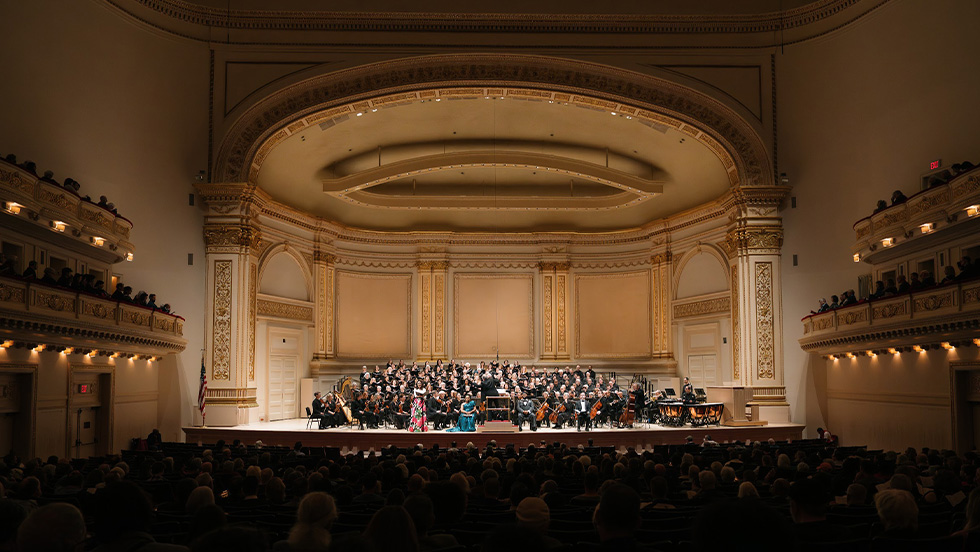
The Pulitzer Prize–winning composer’s new oratorio, All Shall Rise, is the third chapter of a trilogy that traces 250 years of the country’s struggle for equality.
University Professor Paul Moravec, DMA, is one of Adelphi’s most decorated faculty members. He’s won a Pulitzer Prize, received a Guggenheim Fellowship and been nominated for a Grammy Award. Now, he can add a completed trio of Carnegie Hall premieres to the list.
Last year, All Shall Rise, the third and final oratorio in his American Voices Trilogy (commissioned by the Oratorio Society of New York), premiered at Carnegie Hall. It follows the first two chapters of the trilogy, Sanctuary Road—nominated for a Grammy Award for Best Choral Performance at the 63rd Annual Grammy Awards—and A Nation of Others, which premiered at Carnegie Hall in 2018 and 2022. Together, these works chart 250 years of the American struggle for equality, celebrating the stories of our nation’s unsung heroes.
But where Sanctuary Road and A Nation of Others explore particular moments in American history—the Civil War and a single day on Ellis Island in 1921, respectively—All Shall Rise traces the evolution of voting rights from 1789 to today. The piece’s breadth “suggests the history of the widening circle of enfranchisement, beginning with the founding of the country,” Moravec said. So does the title. “Enfranchisement eventually expands to involve everybody, to elevate them. It’s a kind of rising—all shall rise.”
Moravec worked with librettist Mark Campbell, his writing partner for the American Voices Trilogy, to pair real-life history with fictional representations of American voters. All Shall Rise interpolates excerpts of writings and speeches from figures like Benjamin Franklin, Frederick Douglass and German-American suffragist Mathilde Franziska Anneke. Alongside these are the stories of imaginary lives that were shaped by them. Campbell and Moravec invented several characters who could narrate their own relationships to enfranchisement through the years: “ordinary people caught up in extraordinary circumstances,” as Moravec once put it.
For Moravec, the heart of All Shall Rise beats in the character of Lily, a Black woman voting for the first time in her life after the passage of the 1965 Voting Rights Act. As Lily tries to enter an Alabama courthouse to cast her vote, facing threats from a white objector, she sings the aria “I Continue On.” “I think it’s the most inspiring and moving story in the piece,” Moravec said. Although Lily’s story is one of many woven throughout the libretto, she returns in the final scene to remind the audience of her resilience—and how we all must “continue on” in holding the line of enfranchisement.
Music director of the Oratorio Society of New York Kent Tritle, who conducted the premieres of each work in the trilogy, told Broadwayworld.com that Moravec’s use of the oratorio—defined as a large- scale concert piece for orchestra and voices—puts him in conversation with some of history’s greatest composers. “What’s wonderful about these pieces is that they bring a new perspective to a form that’s been around for hundreds of years, including notable works by Bach, Handel, Haydn and Mendelssohn,” Tritle said.
“Oratorios are great for big stories, big ideas, big emotions held by lots of people,” Moravec explained. “When you have a chorus of one hundred people onstage singing full blast, it’s like the whole world is singing.” But behind this intensity of sound lies clarity. Moravec believes an oratorio has to “work” on the first listen, which means his musical voice must speak as clearly and directly as possible to the audience. At the same time, however, the score is musically complex, a challenge to perform. It’s these qualities, he believes, that “hold the piece together. It’s the tension that keeps you listening.”
No matter where Moravec seeks out the next honor for his mantle, he knows he’ll always have a home at Adelphi. Since joining the faculty in 2004, he has helped elevate the reputation of the University’s music program, working one-to-one with students to help them define their creative voices and shepherd their compositions to completion. “I’m very grateful to Adelphi for having given me so much support and so many opportunities to create music,” he said. “I, too, continue on.”
Frequently Asked Questions
The American Voices Trilogy is a series of three oratorios by Paul Moravec, with librettos by Mark Campbell. The Oratorio Society of New York commissioned the works, and all three premiered at Carnegie Hall. Together they cover 250 years of the American struggle for equality and celebrate the country’s unsung heroes.
- Sanctuary Road (premiered 2018) is set during the Civil War.
- A Nation of Others (premiered 2022) takes place on a single day on Ellis Island in 1921.
- All Shall Rise is the final work. It follows the history of voting rights from 1789 to today.
All Shall Rise traces how voting rights in the United States expanded from the country’s founding to the present day. It mixes excerpts of writings and speeches by Benjamin Franklin, Frederick Douglass and suffragist Mathilde Franziska Anneke with invented characters whose lives were shaped by those rights. Moravec describes those characters as “ordinary people caught up in extraordinary circumstances.”
According to Moravec, the title reflects “the widening circle of enfranchisement.” Over time, the right to vote grew to include everyone and to “elevate them. It’s a kind of rising—all shall rise.”
An oratorio is a large-scale concert piece for orchestra and voices. Bach, Handel, Haydn and Mendelssohn all wrote famous ones. Moravec says oratorios “are great for big stories, big ideas, big emotions held by lots of people.”