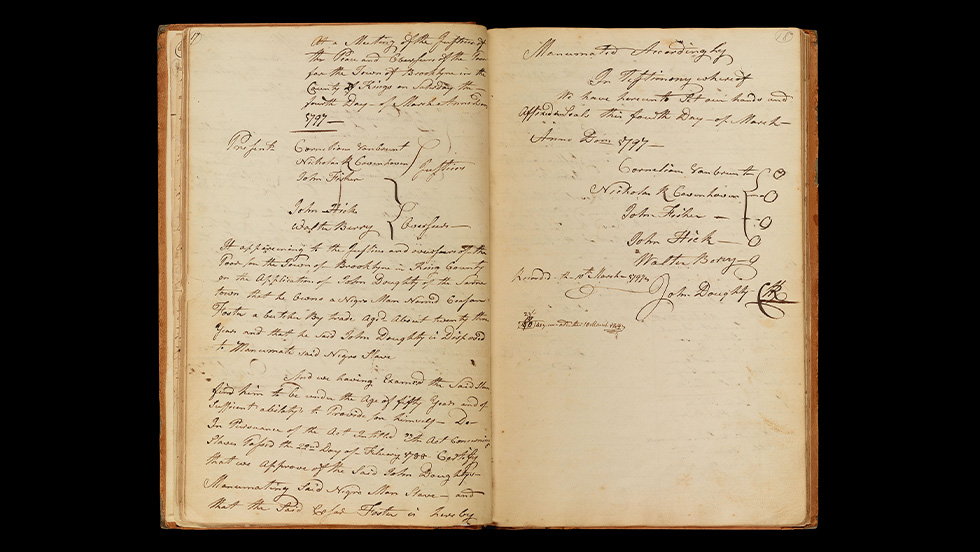
An Adelphi assistant professor turned 134 manumission records into a free, searchable resource, giving descendants a new way to trace Black ancestors in early Brooklyn.
Before Brooklyn had brownstones, a navy yard or high-rises, it had farms. “Picture Brooklyn in the 1700s as acre upon acre of completely flat farmland,” said Christopher Barnes, PhD, assistant professor and digital publishing librarian in the University Libraries, who recently built a large dataset from records of the period. In the 18th century, the borough we now know as Brooklyn, at the time comprising six towns—Brooklyn, Bushwick, Flatbush, Flatlands, Gravesend and New Utrecht, all under the banner of Kings County—was home to fields of corn, wheat, rye, barley and other grain crops. Farming these crops depended on the labor of enslaved people, making the institution of slavery a key lever of Brooklyn’s economy.
“We tend to think of New York and New Jersey as aligned with New England in the North-South slavery divide,” said Dr. Barnes, “but those two states were some of the largest slaveholding areas in the country.” In 1799, New York passed legislation that enshrined the practice of manumission, or legal emancipation from slavery through a formal contract. A number of enslaved people successfully attained their freedom in this way before New York outlawed slavery in 1827. These names survive in the Old Town Records collections, which have been freshly digitized by the New York City Municipal Archives.
On their own, digital images of records are difficult to work with, according to Dr. Barnes. He partnered with Enslaved.org—an open-source database on the trans-Atlantic slave trade—to turn a mass of primary source scans into a sophisticated, fully searchable dataset.
“Manumissions in the Brooklyn Old Town Records Collection, 1797-1825” (Journal of Slavery and Data Preservation, April 2025) documents Dr. Barnes’ efforts to collect, organize and analyze the 134 manumissions on record with Kings County. For Dr. Barnes, each of these instances—and the names, dates and biographical details that accompany them—represents a crack in the “brick wall” of Black American genealogy. With every manumission now searchable through Enslaved.org, “the descendant of someone who had been manumitted in Brooklyn might finally be able to connect the dots,” he explained.
Once an individual was manumitted, they could be counted in the census, opening up endless genealogical possibilities. The earliest manumission in the collection, from 1797, concerned a man named Cesar or Ceaser Foster, whose trade was listed as “butcher.” Dr. Barnes’ research revealed that a free Black man named Cesar Foster of roughly the same age lived and worked as a butcher in Albany in 1815. The 1820 national census also listed a Black man named Ceasar Foster living with a woman and child. More research is needed to prove the connection, but, Dr. Barnes said, “It’s proof that the possibilities are there.”
While this particular dataset is complete, Dr. Barnes’ genealogical work is not. As the descendant of Long Island slaveholders, he has a personal investment in, as he puts it, using “white genealogy to help recover Black history.” Currently, he is building his own digital humanities project, a website that centers on the lives of the 200- plus individuals once enslaved by his ancestors. Some descendants of those enslaved individuals have even reached out to him, and together they’ve been working to create a shared genealogical tree.
Dr. Barnes is eager to get the Adelphi community involved in the digital preservation of slavery records. For International Open Access Week 2025, he and the managing editor of Enslaved.org’s Journal of Slavery and Data Preservation, Kristina Poznan, PhD, presented to students and faculty on the website’s commitment to keeping its content free and machine readable. He has also been coordinating with Adelphi’s Department of African, Black and Caribbean Studies to host a talk on the history of slavery in the area. Next, Dr. Barnes would like to get students working on a dataset that captures manumissions from local historical records, particularly those from a Quaker community in Jericho whose members were abolitionists and frequently manumitted their enslaved workers.
For now, however, he’s content to imagine different ways to “cross-pollinate” as a librarian, scholar and educator. “My job is all about open access and digital scholarship, and I got to combine them with my passion for New York City history in this project,” he said. “It was a perfect match for my position at Adelphi.”
Frequently Asked Questions
“Manumissions in the Brooklyn Old Town Records Collection, 1797–1825” is a searchable dataset built by Christopher Barnes, PhD, of Adelphi University Libraries. It covers 134 recorded manumissions in Kings County and was published in the Journal of Slavery and Data Preservation in April 2025. Every record is searchable on Enslaved.org.
Manumission is the legal freeing of an enslaved person through a formal contract. In New York, a number of enslaved people gained their freedom this way before the state outlawed slavery in 1827.
Yes. In the 1700s, Brooklyn was made up of farmland across six Kings County towns: Brooklyn, Bushwick, Flatbush, Flatlands, Gravesend and New Utrecht. Farms growing corn, wheat, rye and barley depended on enslaved labor.
Records of enslaved people often lack names and dates, which creates a “brick wall” for descendants. Manumission records list names, dates and biographical details. Once freed, people could also be counted in the census, which opens new ways to trace family lines.
All 134 manumissions in the dataset can be searched for free on Enslaved.org, an open-source archive on the trans-Atlantic slave trade.