On September 11, 2001, history did not just unfold on television screens across the globe—it hit directly at the heart of the Adelphi University community.
From classrooms on campus to the upper floors of the World Trade Center, the lives of Adelphi students, faculty, alumni and leadership were irrevocably intersected by catastrophe. Twenty-five years later, their stories reveal how a single morning continues to echo across generations, offering a timeless blueprint of resilience, community and courage.
“Time Seemed to Stand Still”: President Michael Balboni’s Classroom Recollections
For Adelphi University President Michael Balboni ’81, JD, September 11, 2001, began in a classroom. Then a New York state senator, he was serving as an adjunct faculty member, teaching a political science class on campus, when he received a phone call with the unbelievable news.
“Time seemed to stand still,” President Balboni recalled in a message sent to the Adelphi community on the eve of the 25th anniversary. “In that classroom, fear, confusion and grief washed over us, but so did a profound sense of shared humanity.”
That shared ordeal forged an indelible bond between President Balboni and his students—one he carries with him to this day. In the painful weeks that followed, he attended dozens of memorial services for constituents, neighbors and friends. Yet amid immeasurable sorrow, he discovered enduring hope in the quiet resilience of ordinary people—those who chose, day after day, to board trains back into a city with a smoldering skyline, displaying their own powerful brand of bravery.
For current Adelphi students who were too young to remember or not yet born, President Balboni emphasizes that 9/11 remains an active lesson in human strength. “You do not need to wear a uniform or rush into a burning building to be brave,” he wrote. “Courage is often found in the resolve to keep moving forward, to lend a voice of comfort to those who are grieving, and to show up for your community when it is hardest to do so.”
Inside the Tower: Dr. Nicholas Cagliuso’s Survival and the Lifelong Call to Serve
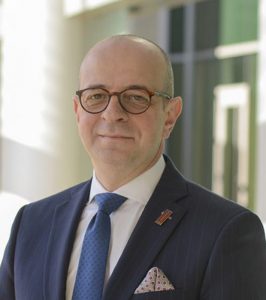
Nicholas Cagliuso Sr., PhD, MPH
While news was reaching the Adelphi campus, Nicholas Cagliuso Sr., PhD—now an adjunct faculty member in Adelphi’s Emergency Management Program—was at ground zero itself.
Dr. Cagliuso had recently started a job on the 86th floor of the World Trade Center’s North Tower. He arrived that morning at about 8:20. About 25 minutes later, the plane struck the building.
To Dr. Cagliuso, the initial impact felt like an air conditioner blowing out. Soon, however, thick smoke began to roll in. Looking out the window, he saw desks, tables and office chairs falling past the glass. Acting quickly, he used a hammer to break a floor-to-ceiling window to bring crucial oxygen into the smoky room, creating a rush of wind so powerful it nearly tore a door off its hinges.
As Dr. Cagliuso and two co-workers entered the stairwell to begin their descent, his decade of EMT experience and fire service training kicked in: Assess what is happening, then act.
The journey down was treacherous. As the building shifted, stairwell doors jammed, forcing them to find alternate routes past darkened elevator shafts. Along the way, Dr. Cagliuso stopped to assist when Port Authority police called for CPR-trained responders, helping a struggling women down a flight of stairs.
As he neared the mezzanine, the South Tower collapsed, shaking the North Tower violently. Firefighters breached a wall to redirect evacuees to another staircase. Stepping onto the mezzanine level, Dr. Cagliuso spotted two airplane seats lying amidst the debris.
Finally reaching the street, he fled the complex. Approximately 10 minutes later, the North Tower collapsed. He walked across the Brooklyn Bridge to fire headquarters, eventually reuniting with his wife and father.
Looking back, Dr. Cagliuso does not view September 11 as a sudden turn in his life, but as a “crystallizing moment” that reaffirmed his devotion to public service. Today, he brings that lived experience directly into the Adelphi classroom, teaching emergency management students the practical realities behind safety theories. He stresses preparedness, vigilance and the importance of helping others.
“Our Lives Have Changed”: The View From Campus
Back on campus in Garden City, shock quickly turned to a collective effort to comprehend the tragedy.
Just two weeks into her first year at Adelphi, Amanda Barbieri ’05 watched the chaos unfolding in Lower Manhattan on a television in her dormitory’s common area. The reality hit close to home for the campus community. Many were terrified because they had family members who worked in or around the Twin Towers.
The personal impact was staggering for young students. “It was terrifying because the week before, I had gone up to the observation deck of the Twin Towers,” Barbieri recalled in an interview published this fall on September 10 in USA Today. “I couldn’t imagine getting out of there once you were in.”
Looking back, Barbieri, now a behavioral therapist, noted how profoundly the event shaped her outlook on life. “As a kid, I don’t know if I really understood it yet,” she reflected, fighting back tears. “But I know as I’ve gotten older, nothing is ever promised. That was something that was there one minute, and gone the next, along with the people that were in it.”
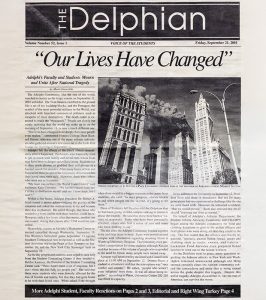
The front page of the September 21, 2001, issue of The Delphian
Just 10 days after the towers fell, The Delphian, Adelphi’s student newspaper, captured this exact heartbreak and sense of suspended reality across campus.
“Our Lives Have Changed,” read the bold page one headline of The Delphian. “The death toll is expected to reach ‘the thousands.'” An editorial summarized the inescapable reach of the tragedy across the University community: “There may not be a person at Adelphi University who has not, in one way or another, been affected by this tragedy.”
Community Members Lost
The fears expressed on the pages of The Delphian were realized for many in the Adelphi family.
Among those lost was James Ostrowski ’88, who was working as a bond broker on the 104th floor of the North Tower at the Cantor Fitzgerald office. When American Airlines Flight 11 struck the building at 8:46 a.m., it hit directly below Cantor’s offices, severing all stairwells and elevator shafts in the impact zone and cutting off any chance of escape. Ostrowski died alongside 657 of his colleagues, just one day before his ninth wedding anniversary. He was 37 years old and left behind his wife and three young children.
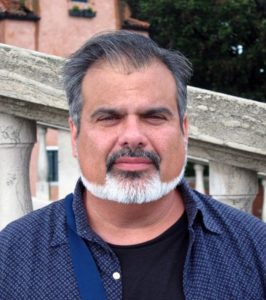
Professor of art and art history Christopher Saucedo
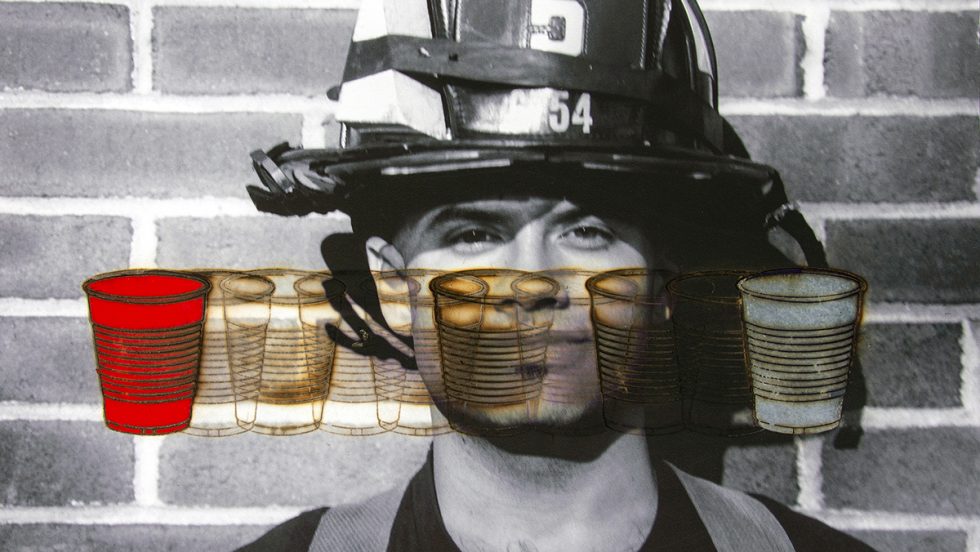
Christopher Saucedo, a professor of art and art history who joined Adelphi’s faculty in 2012, lost his brother Gregory, a New York City firefighter, in the attack. Deeply affected by his brother’s death, Professor Saucedo created a series of works honoring him and others who perished that day. The series, Requiem MMI, includes portraits of his brother along with images of the World Trade Center floating on an azure background. Requiem MMI is on view at Adelphi as part of the University’s remembrance on the 25th anniversary of the attacks.
Describing the works, Professor Saucedo wrote, “I wanted the works to exist outside of time, both before and after September 11, 2001. I needed it to remind me of the event that changed everything and still not make me sad. Mostly I wanted to see that blue sky and hopefully hear the voice of a cherished friend, if only as a distant echo.”
Twenty-five years later, his story, along with those of President Balboni, Dr. Cagliuso, student journalists and those who perished, form an essential tapestry of Adelphi’s history. They serve as a poignant reminder that while 9/11 reshaped our world forever, the spirit of community, service and quiet courage remains unbroken.