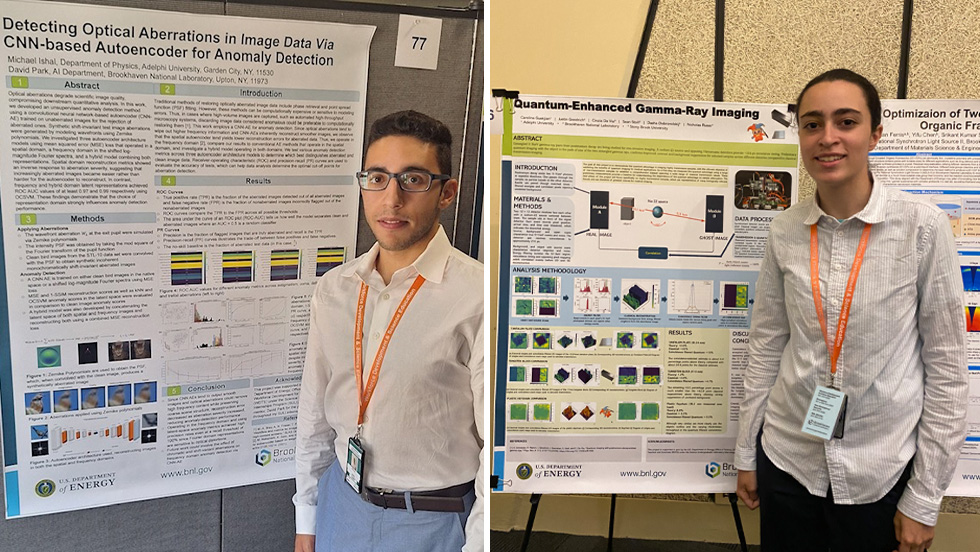
A pair of Adelphi physics majors spent their summer as interns at the U.S. Department of Energy's Brookhaven National Laboratory exploring new frontiers in imaging.
Research is a foundation of the undergraduate experience at Adelphi. It is promoted by the University’s SPARK Center and Innovation Center, the annual Scholarship and Creative Works Conference (known as Research Day) as well as numerous summer internship programs. To further facilitate research, Adelphi has also developed partnerships with businesses and organizations that offer research opportunities and internships at various facilities, allowing students to advance their skills, discover potential careers and enhance their résumés.
One of Adelphi’s premier partners is Brookhaven National Laboratory. Located on Long Island, Brookhaven’s 5,300-acre campus contains several large facilities devoted to research in nuclear and high-energy physics, environmental and bioscience, and energy science and technology. The lab has racked up numerous achievements over the years, including seven Nobel Prize-winning discoveries and 37 R&D 100 Awards.
As a science partner of the University, Brookhaven has welcomed many Adelphi students as interns over the years. This summer, two Adelphi physics majors—current seniors Michael Ishal and Carolina Guekjian—earned internships to conduct scientific research there. Both explored new frontiers in imaging.
Doing Research in AI and Computational Imaging
Michael Ishal, who is majoring in physics, still remembers what drew him to Adelphi. “There was a day dedicated to students who were considering Adelphi physics, where we could talk with physics professors and learn from them,” he recalled. “Additionally, we were able to sit in on classes as well. The physics professors were full of energy, and they were truly excited to teach. They encouraged curiosity and challenged students to think critically.”
One of those professors was Kevin Liang, PhD, an associate professor in the department, who had been discussing a concept that day known as Rayleigh’s criterion. Little did Ishal know, three years into his Adelphi career, he and Dr. Liang would work together on research related to Rayleigh’s criterion and would prepare a publication based on that very research.
Ishal tackled other research opportunities at Brookhaven National Laboratory when he enrolled last academic year in a Workforce Development & Science Education (WDSE) mini-semester program. There, he and his fellow students toured the scientific facilities and observed research projects while interacting with world-class scientists and engineers. One of those research projects, conducted by David Park, PhD, attracted Ishal’s interest. “After asking him if he was accepting interns, Dr. Park asked me to check out some of his publications,” he explained, “and then send him an email discussing my research more in depth.” Ishal sent an email that night. The day after, when the mini-semester ended, Ishal received an internship offer .
Ishal’s internship experience was related to research he had done at Adelphi on flaws in lenses or mirrors that distort images, also known as optical aberrations. Working in Brookhaven’s Computing and Data Sciences department, he focused on AI and computational imaging, testing neural network-based methods to detect whether images are degraded by optical aberrations. Dr. Park assisted him in this research, serving as his mentor.
“The experience taught me the importance of both collaboration and independence, expanding your domain of knowledge through literature searches, and how research can lead to valuable, unexpected results,” Ishal said. “Working with talented researchers strengthened my skills in machine learning, data analysis and AI research, which gave me a strong foundation as I continue my education and pursue future career opportunities.”
Doing Research That May Help Transform Medicine
Heading into college, Carolina Guekjian knew that she wanted to major in physics. “I saw all the possibilities of how physics can make incredible impacts on our future,” she said. “I wanted to be one of the ones that contribute to it.” The challenge now was figuring out where to pursue this field of study. “I spoke to previous Adelphi students who praised the professors and how they truly care about their students,” Guekjian said. “As I toured the physics department, I learned about all the interesting things that I would be learning.”
As a physics major, Guekjian has been involved in academic research since her first year. She worked closely with Sean Bentley, PhD, an associate professor in the department, researching a strange physical phenomenon known as quantum entanglement. She later had the opportunity to tour Brookhaven, where she learned about the lab’s research in that area. Intrigued, Guekjian decided to pursue an internship opportunity related to that research. She was accepted.
As an intern, Guekjian was able to observe experiments in quantum entanglement conducted through the National Synchrotron Light Source II Beam Lines, which allows researchers to study materials with nanoscale resolution. She also had the opportunity to see the inside of the detectors used at the Relativistic Heavy Ion Collider, as Brookhaven began dismantling equipment and preparing for the transition to the Electron Ion Collider.
Guekjian also, of course, continued her own research at Brookhaven, investigating quantum entanglement’s ability to produce images at a spectacularly high level of resolution. The technology has the potential to transform medical imaging, enabling it to discover diseases at their earliest stages.
Her research has been going well—so well, in fact, that she was offered the opportunity to extend her internship into the school year and continue her work at Brookhaven.