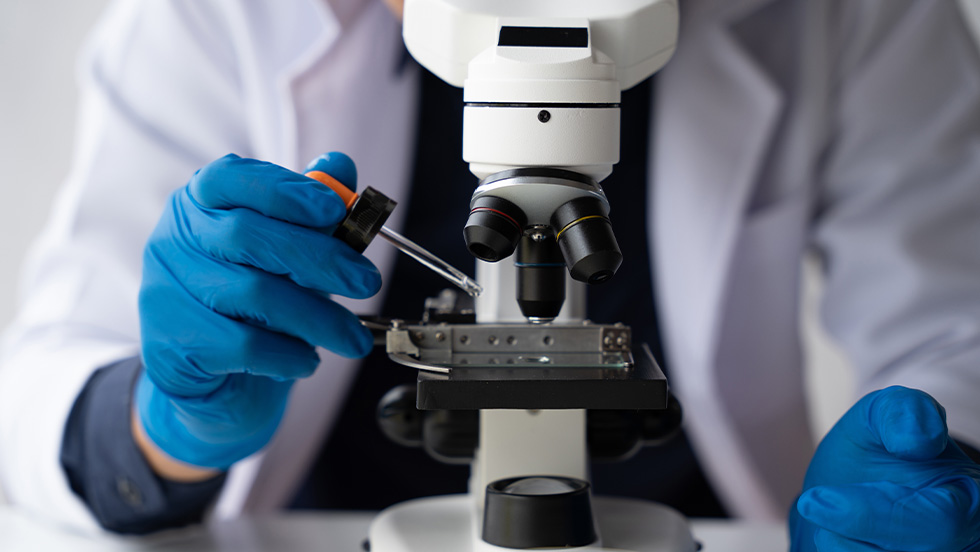
Chemistry professor Michael Lueckheide, PhD, helps advance next-generation mRNA delivery systems and trains undergraduates on the same equipment used in the pharmaceutical industry.
Development of the COVID-19 vaccine within a year of lockdown may have seemed like a miracle to many, but scientists already had a half-century of research on messenger RNA (mRNA) gene therapies at their disposal. Michael Lueckheide, PhD, assistant professor of chemistry, who himself has contributed to the study of breakthrough mRNA technology, knows all about the process of developing lifesaving biopharmaceutical knowledge—as well as preparing the next generation of scientists to explore the frontiers of medical research.
Prior to his appointment at Adelphi, Dr. Lueckheide collaborated with a long-standing research team led by renowned chemist Robert Waymouth, PhD, of Stanford University. For years, the Waymouth group has been working to understand the factors governing the self-assembly of mRNA with cationic polymer molecules, crucial components in the creation of effective mRNA vaccines. Their most recent findings, which include Dr. Lueckheide’s contributions, are discussed in the paper “The Structure and Morphology of Single- Component Oligomeric RNA Delivery Vectors Derived from Amphiphilic Charge-Altering Releasable Transporters” (ACS Nano, November 2025).
Dr. Lueckheide joined the National Institute of Standards and Technology (NIST) in 2019 as a postdoctoral fellow in the Polymers and Complex Fluids group under the supervision of Vivek Prabhu, PhD. There, he collaborated with the Waymouth group to study biomolecules and polymers using the agency’s nuclear reactor. He had been tasked with obtaining, through subatomic scattering, structural data about the RNA particles that the team had deemed most promising. When building an effective vaccine, “We have to know the shape, the size and the form of the particles, inside and out,” he said. “Those features have direct connections to how a vaccine-particle will behave once it’s in our bodies. It’s not enough to mix mRNA with molecules in a plastic tube and say, ‘Here, it’s done.’”
The basic goal of any vaccine is to introduce an outside pathogen or blueprint to the body’s natural defenses to promote immune response and memory. Historically, mRNA vaccines have worked by associating negatively charged mRNA molecules with positively charged lipids to make nanoparticles that will later release the mRNA to deliver its pathogen-mimicking lesson to our bodies.
But a fully lipid-based delivery system has major limitations. “Vaccine producers need to confirm that lipid particles are made reproducibly,” Dr. Lueckheide said. “Will you get the same thing every time you try to make this vaccine? Can you ensure you’re sending the same thing to every patient, every hospital?”
Controlling the possibility of lipid variations can drive up the cost of mRNA vaccines, so researchers began to develop synthetic alternatives, which provide greater dose-to-dose consistency. However, the process is a long one. The Waymouth group’s work began nearly two decades ago, with new collaborators, like Dr. Lueckheide, regularly coming on board to lend their expertise.
This latest 2025 paper, “The Structure and Morphology …,” builds on the group’s successful history of developing polymer-based mRNA delivery systems. It describes the structure of a new system that can introduce mRNA into cells and then release the mRNA in response to subsequent pH changes. With this structural information in hand, pharmaceutical companies can improve the accuracy and efficiency of their therapeutic manufacturing.
Medical advancements rely on this kind of intergenerational research. For Dr. Lueckheide, imparting the value of teamwork and mentorship to his undergraduate students at Adelphi is critical. He also strives to help them get a foothold in the biopharmacology industry—and make a real-world impact—as early as possible. “I wanted to bring to Adelphi the kind of medically relevant research I had the opportunity to experience as a student and postdoctoral fellow,” he said. Adelphi’s chemistry labs contain the caliber of analysis equipment that students will see used by pharmaceutical companies (including nuclear magnetic resonance spectroscopy, light scattering and high- performance liquid chromatography), so Dr. Lueckheide conscientiously trains them to be fluent in industry techniques and technologies.
Currently, as part of an ongoing research manuscript, Dr. Lueckheide’s students are learning how to study simpler assembling molecules and how to make and study more complex assembling polymers. “Once they’ve made those molecules,” he said, “then they need to do quality control and use our lab equipment like any professional would. This particular manuscript may not be earth-shattering, but it’s work that undergraduates figured out how to do, and now they’ll be able to apply those same research methods to more complex systems.”
And so, the cycle of innovation continues.
Frequently Asked Questions
mRNA vaccines introduce a pathogen-mimicking blueprint to the body’s natural defenses to promote immune response and memory. Historically, they have paired negatively charged mRNA molecules with positively charged lipids to form nanoparticles that later release the mRNA into the body.
Lipid particles can vary from batch to batch, and controlling that variation can drive up the cost of mRNA vaccines. Synthetic alternatives, such as the polymer-based systems studied by Robert Waymouth, PhD, and his group at Stanford University, provide greater dose-to-dose consistency.
The paper, published in ACS Nano in November 2025, describes the structure of a new system that can introduce mRNA into cells and then release it in response to pH changes. It reflects work by the Waymouth group, including contributions from Michael Lueckheide, PhD, assistant professor of chemistry at Adelphi University. With this structural information, pharmaceutical companies can improve the accuracy and efficiency of therapeutic manufacturing.
A particle’s shape, size and form are directly connected to how a vaccine behaves once it is in the body, according to Dr. Lueckheide. As a postdoctoral fellow at the National Institute of Standards and Technology (NIST), he gathered structural data on promising RNA particles through subatomic scattering at the agency’s nuclear reactor.
Adelphi’s chemistry labs include analysis equipment of the caliber used by pharmaceutical companies, including nuclear magnetic resonance spectroscopy, light scattering and high-performance liquid chromatography. Dr. Lueckheide trains undergraduates to be fluent in these industry techniques and technologies.